
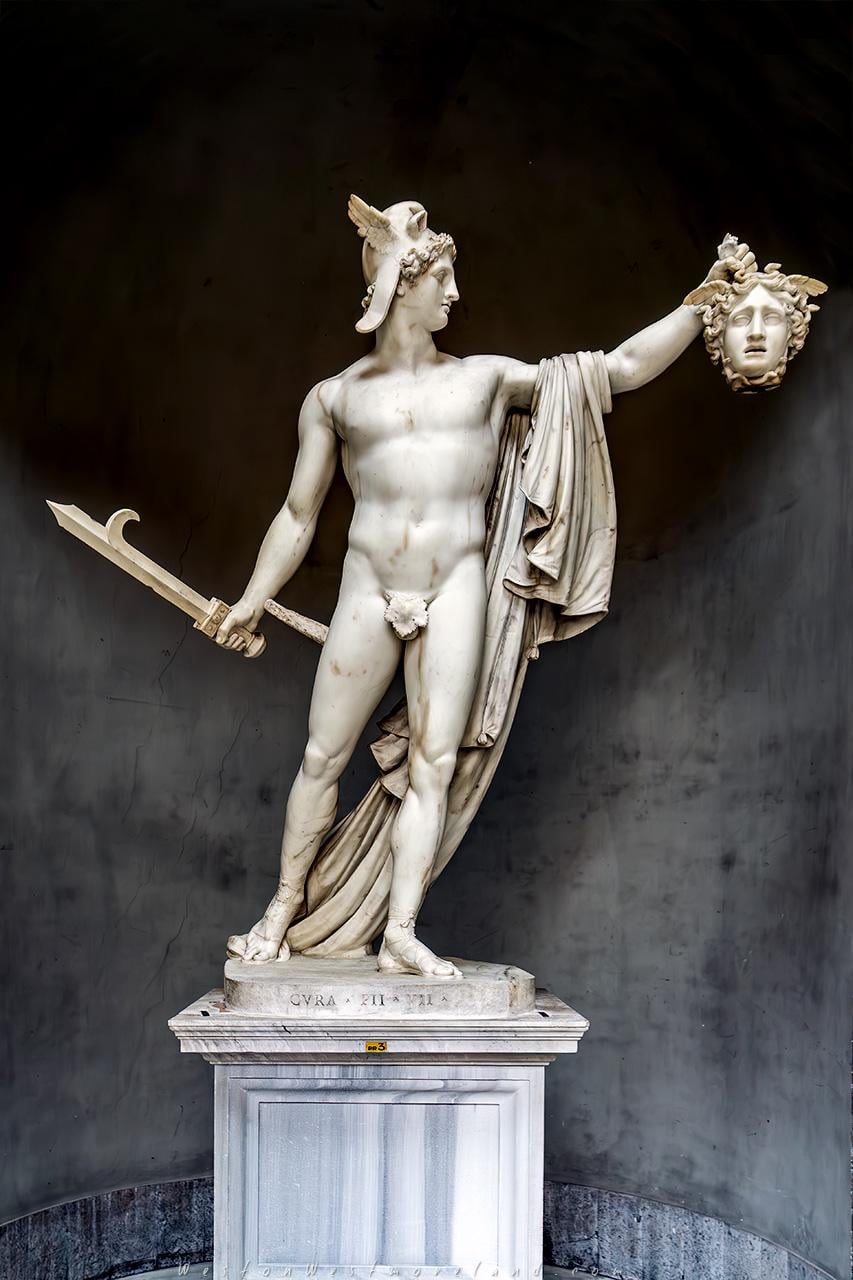
Perseus Triumphant, Antonio Canova, 1801. The statue shows the triumphant Perseus holding the severed head of the Medusa, one of the three Gorgons. He is looking at her face, even though that should turn him into stone according to the myth. Perseus is wearing the sandals of… [1280×853] [OC]
by WestonWestmoreland
3 Comments
…the messenger god Hermes, which allowed Perseus to fly. These sandals were made of gold by the god Hephaestus. Perseus also wears the cap of Hades hanging loosely over his arm, which could make him invisible. Furthermore, Perseus is holding a harpe sword, a sword with a sickle-like extension on one side of the blade. The sword was owned by Zeus, the father of Perseus.
In Greek mythology, Perseus is the legendary founder of the Perseid dynasty. He was, alongside Cadmus and Bellerophon, the greatest Greek hero and slayer of monsters before the days of Heracles. He beheaded the Gorgon Medusa for Polydectes and saved Andromeda from the sea monster Cetus. He was a demigod, being the son of Zeus and the mortal Danaë, as well as the half-brother and great-grandfather of Heracles (they were both children of Zeus, and Heracles’s mother was Perseus’s granddaughter).
Because of the obscurity of the name “Perseus” and the legendary character of its bearer, most etymologists presume that it might be pre-Greek; however, the name of Perseus’s native city was Greek and so were the names of his wife and relatives. There is some idea that it descended into Greek from the Proto-Indo-European language. In that regard the only Greek derivation available of the name Perseus might be from the Greek verb pérthein (πέρθειν) “to waste, ravage, sack, destroy”, some form of which is familiar in Homeric epithets. The -eus suffix was typically used to form an agent noun, in this case from the aorist stem, pers-. Pers-eus therefore is a “sacker (of cities)”, that is, a soldier by occupation, a fitting name for the first Mycenaean warrior.
This statue was carved by Antonio Canova (1757-1822) in the space of a few months between the end of the year 1800 and the beginning of 1801. Made for the tribune Onorato Duveyriez, the first owner of the statue.
Perseus is displayed with his left foot standing in the front while the heel of his right foot is lifted, creating the sense that Perseus is moving forward.
Antonio Canova made this statue twice. The first version, this one, is on display in the Vatican Museums and is also known as Perseus Triumphant. A replica by Canova is in the Metropolitan Museum of Art. The head of Medusa in this statue has been inspired by the Medusa Rondanini, a marble sculpture that is in the Glyptothek in Munich.
The rest of the statue has been heavily inspired by the Apollo Belvedere, a famous statue from antiquity, which is also in the Octagonal Court of the Vatican Museums. The first version of the statue of Perseus and Medusa was acquired by Pope Pius VII to replace the Apollo Belvedere which Napoleon Bonaparte had confiscated and shipped to the Louvre in Paris. When the Apollo Belvedere returned to Rome, they kept the statue of Canova as it was such a great piece of work. When the second version of this statue first arrived at the Metropolitan Museum of Art, the sword was missing. They took a cast from the version in the Vatican Museums and added a newly carved marble sword to the statue.
Personally, I prefer hands down [Cellini’s sculpture of Perseus](https://www.reddit.com/r/ArtefactPorn/comments/11sqnny/perseus_and_medusa_a_bronze_sculpture_made_by/). And as for Canova, I prefer hands down his [Psyche Revived by Cupid’s Kiss](https://www.reddit.com/r/ArtefactPorn/comments/v4mrb5/psyche_revived_by_cupids_kiss_by_antonio_canova_c/) than this Perseus. I don’t like this one very much to be honest, but who am I to judge right?
My apologies for inaccuracies and mistakes.
But this is stone, right? 😆
The fact that he’s looking at the head was the first thing I noticed. But maybe that’s why he’s made of stone?