
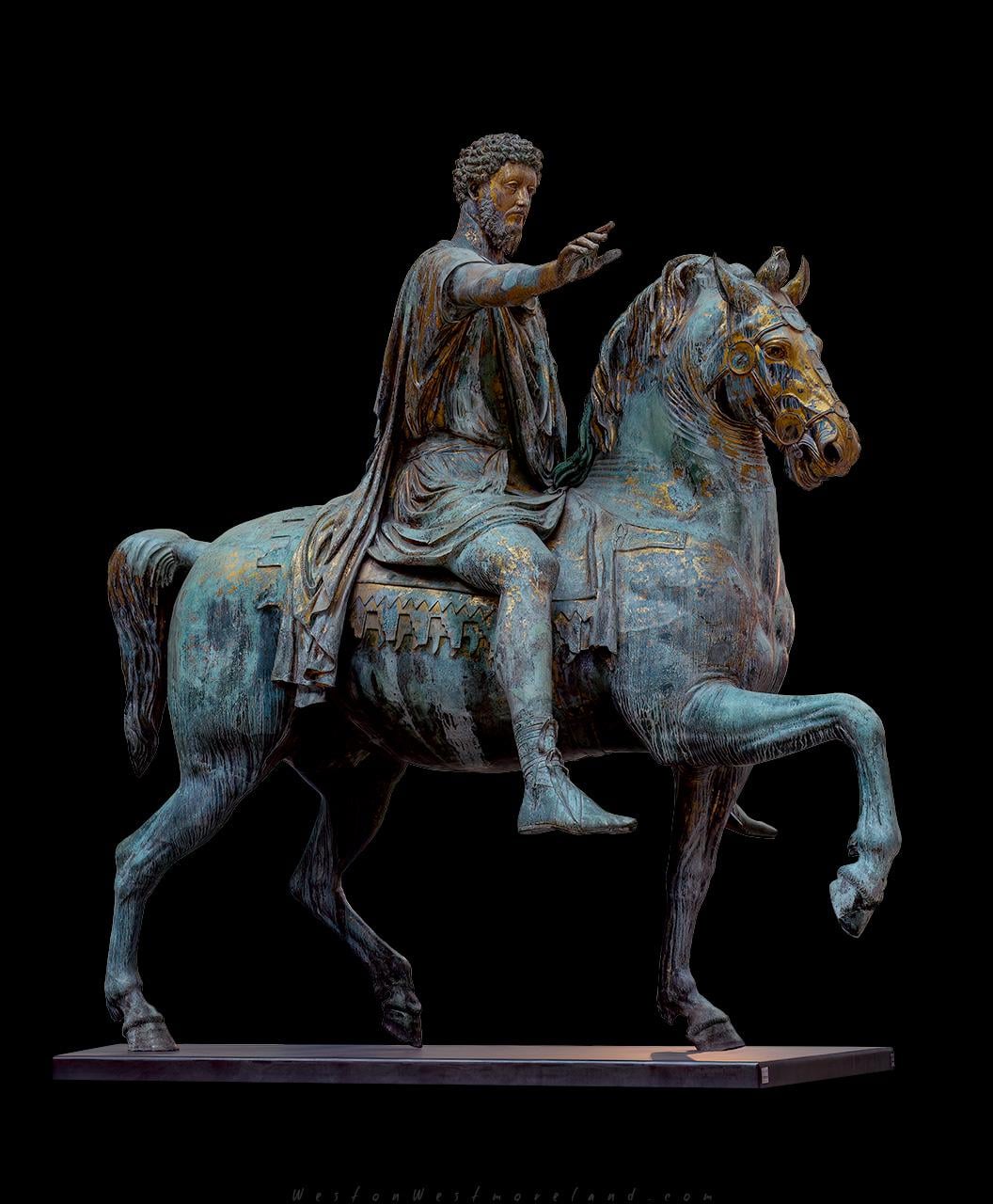
Equestrian statue of Marcus Aurelius, Rome, 176 AD. One of the greatest surviving works of Roman imperial art, it is the only large bronze imperial equestrian statue to survive, largely because M. A. was confused with Christian emperor Constantine and escaped being melted down… [1280×1056] [OC]
by WestonWestmoreland
2 Comments
…It was originally gilded bronze, giving it a brilliant golden appearance.
Marcus Aurelius was the last of the ‘Five Good Emperors’ who governed Rome during the Pax Romana period (27 BC to 180 AD). He ruled during a complicated period with external threats and internal strife. The monument reflects on his dedication and duty to bringing traditional Roman values to the ancient city.
It is thought there were as many as 22 equestrian statues at the time. These statues were called *‘equi magni’* meaning ‘great horses’, which is larger than life-size, like the monument to Marcus Aurelius. The Bronze Marcus Aurelius statue however, is the only statue of its kind to have survived throughout the years, existing in the present day. These ‘great horses’ were seen as mediums which served the purpose of honoring the emperor for military and civic accomplishments.
The work is usually dated to around 176 CE, in connection with Marcus Aurelius’ triumph over Germanic and Sarmatian tribes, or shortly after his death in 180 CE. Its original location is unknown, but scholars tend to favor either a position in or near the Roman Forum or a monumental square around the Column of Marcus Aurelius (*Piazza Colonna* area).
Marcus Aurelius appears in civilian or civic dress (tunic and cloak) rather than full military armor, emphasizing his role as a just ruler and philosopher‑emperor rather than a mere warlord. His raised right hand combines the gesture of public address (*adlocutio*) with an implication of clemency; medieval sources suggest that a defeated enemy may once have been shown crouching under the horse’s raised foreleg.
The horse is rendered with vivid naturalism—one foreleg lifted, neck arched, nostrils flaring—conveying controlled power and movement. The proportions subtly enlarge the emperor relative to the horse, making him appear more imposing while preserving a convincing overall realism.
The statue is cast in bronze using the lost‑wax process, with horse and rider produced in multiple hollow sections that were then joined together, a typical method for large ancient bronzes. Traces and documentary references indicate that the work was originally gilded, reinforcing both its visual impact and its imperial symbolism.
By the early Middle Ages the statue stood at the Lateran Palace, where it was venerated as an image of Constantine. This fact is thought to have ensured its preservation when so many other bronzes of the same period and older were destroyed. In 1538 it was moved to the redesigned *Campidoglio* (I posted a picture of the *piazza* in ArtefactPorn [here](https://www.reddit.com/r/ArtefactPorn/comments/1g75jlt/piazza_del_campidoglio_on_top_of_the_capitoline/)), where Michelangelo created the famous trapezoidal *piazza* with the equestrian statue as its focal point, cementing the work’s status as a canonical model for later equestrian monuments in Western art.
The statue has been kept in the nearby *Palazzo dei Conservatori* since 1990 to preserve it from weather exposure. A high quality copy of the famous statue was placed on the pedestal in *Piazza del Campidoglio* in 1997, but without the gilding present in the original.
Ah, Marcus Aurelius rides without stirrups, because they had not yet been introduced to the Western world. They would reach Europe from China in the middle ages and make possible the era of knights in shining armor…
My apologies for inaccuracies and mistakes.
Thats crazy thanks for sharing