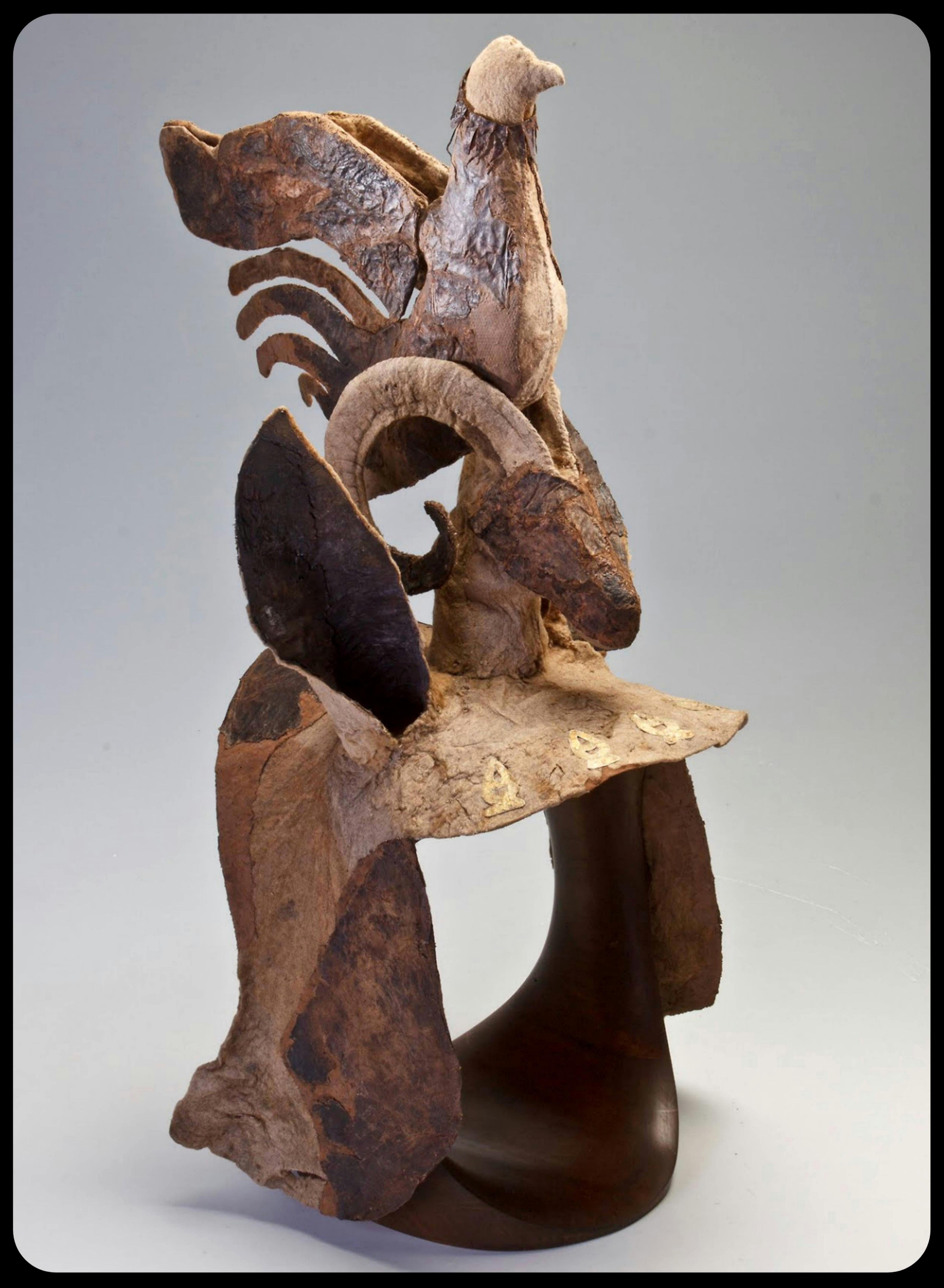
2,300-Year-Old Horse Headdress from Siberia, c.350-300 BCE: this elaborate headgear was designed to be worn by a horse, and it’s decorated with a figure of a rooster perched atop the head of a ram [3858 x 5265]
2,300-Year-Old Horse Headdress from Siberia, c.350-300 BCE: this elaborate headgear was designed to be worn by a horse, and it’s decorated with a figure of a rooster perched atop the head of a ram [3858 x 5265]
This headdress was crafted from leather and gold foil, and it dates back to 350-300 BCE. It was discovered in the frozen barrows of Pazyryk, Siberia, where unique conditions allowed the organic material to remain almost perfectly preserved for more than two millennia.
> The headdress is sewn from felt and leather, and topped with a ram’s head with a rooster-like bird standing between its horns. The bird is detachable, its legs are made of whittled sticks, and its wings were made separately on a rod frame. The peak of the mask is decorated with seven fish made of gold foil.
> A great variety of horse masks were found in the Pazyryk burial mound. Some were peaked and open at the front, while others were closed and entirely covered the horse’s face. All had side flaps tied under the chin with small straps, and ear cases that allowed the mask to sit more securely on the head. They had felt bases covered in leather and were horned.
> Together with their mane covers and tail cases, these masks appeared to transform the horses into fantastic mythical creatures resembling the horned griffins depicted on Pazyryk chieftains’ tattoos and plaques from Peter the Great’s Siberian Collection.
These headdresses were made by ancient Altaic nomads, who formed part of the larger group of cultures that are collectively referred to as the Scythians or Scytho-Siberian peoples.
> It is clear the costumes were not made specifically for the burial: all horse costumes, even the most elaborate, were well-worn and in some places mended, indicating regular use. Because these costumes are impractical for everyday use, they probably were reserved for ceremonial use – and due to their being well-worn, such use was common. As with contemporary Mongolian pastoralists, perhaps these costumes were reserved for the Pazyryk’s seasonal changes of camp, or perhaps for other alternate or additional ceremonies significant to the community.
The Scythians were among the first cultures to begin using horses as mounts, and they invented one of the earliest forms of saddle. They were extremely skilled and accomplished riders, and their early mastery of mounted warfare enabled them to gain control over vast sections of Eurasia. That dynamic led to the development of a very noticeable “horse culture,” with horses playing a critical role in many different aspects of Scythian life (and afterlife).

1 Comment
This headdress was crafted from leather and gold foil, and it dates back to 350-300 BCE. It was discovered in the frozen barrows of Pazyryk, Siberia, where unique conditions allowed the organic material to remain almost perfectly preserved for more than two millennia.
According to [this publication:](https://archive.org/details/st.-john-simpson-svetlana-pankova-scythians-warriors-of-ancient-siberia-thames-hudson-2017/page/231/mode/1up)
> The headdress is sewn from felt and leather, and topped with a ram’s head with a rooster-like bird standing between its horns. The bird is detachable, its legs are made of whittled sticks, and its wings were made separately on a rod frame. The peak of the mask is decorated with seven fish made of gold foil.
> A great variety of horse masks were found in the Pazyryk burial mound. Some were peaked and open at the front, while others were closed and entirely covered the horse’s face. All had side flaps tied under the chin with small straps, and ear cases that allowed the mask to sit more securely on the head. They had felt bases covered in leather and were horned.
> Together with their mane covers and tail cases, these masks appeared to transform the horses into fantastic mythical creatures resembling the horned griffins depicted on Pazyryk chieftains’ tattoos and plaques from Peter the Great’s Siberian Collection.
These headdresses were made by ancient Altaic nomads, who formed part of the larger group of cultures that are collectively referred to as the Scythians or Scytho-Siberian peoples.
Each costume was found on or near a horse’s body, but researchers believe that the costumes were created and used for ceremonial purposes throughout the horse’s life, as [this article](https://www.researchgate.net/publication/319968147_Killing_constructed_horses_Interspecies_elders_empathy_and_emotion_and_the_Pazyryk_horse_sacrifices) explains:
> It is clear the costumes were not made specifically for the burial: all horse costumes, even the most elaborate, were well-worn and in some places mended, indicating regular use. Because these costumes are impractical for everyday use, they probably were reserved for ceremonial use – and due to their being well-worn, such use was common. As with contemporary Mongolian pastoralists, perhaps these costumes were reserved for the Pazyryk’s seasonal changes of camp, or perhaps for other alternate or additional ceremonies significant to the community.
The Scythians were among the first cultures to begin using horses as mounts, and they invented one of the earliest forms of saddle. They were extremely skilled and accomplished riders, and their early mastery of mounted warfare enabled them to gain control over vast sections of Eurasia. That dynamic led to the development of a very noticeable “horse culture,” with horses playing a critical role in many different aspects of Scythian life (and afterlife).
#Sources & More Info:
– Scythians: Warriors of Ancient Siberia: [Horse Headgear](https://archive.org/details/st.-john-simpson-svetlana-pankova-scythians-warriors-of-ancient-siberia-thames-hudson-2017/page/231/mode/1up)
– World Archaeology: [Do the Clothes Make the Horse? Roles, Statuses, and Identities in the Pazyryk World](https://www.academia.edu/8928688/CHAPTER_SIX_Do_the_Clothes_Make_the_Horse_Roles_Statuses_and_Identities_in_the_Pazyryk_World)
– Perspectives and Studies in Ethnozooarchaeology: [Killing (Constructed) Horses: Interspecies Elders, Empathy, Emotion, and the Pazyryk Horse Sacrifices](https://www.researchgate.net/publication/319968147_Killing_constructed_horses_Interspecies_elders_empathy_and_emotion_and_the_Pazyryk_horse_sacrifices)
– University of Leicester: [At Home, with the Good Horses](https://figshare.le.ac.uk/ndownloader/files/18216341) (PDF) (this is a really great paper)
– University of Washington: [Artifacts from Southern Siberia/Pazyryk](https://depts.washington.edu/silkroad/museums/shm/shmpazyryk.html)
– British Museum: [Introducing the Scythians](https://www.britishmuseum.org/blog/introducing-scythians)