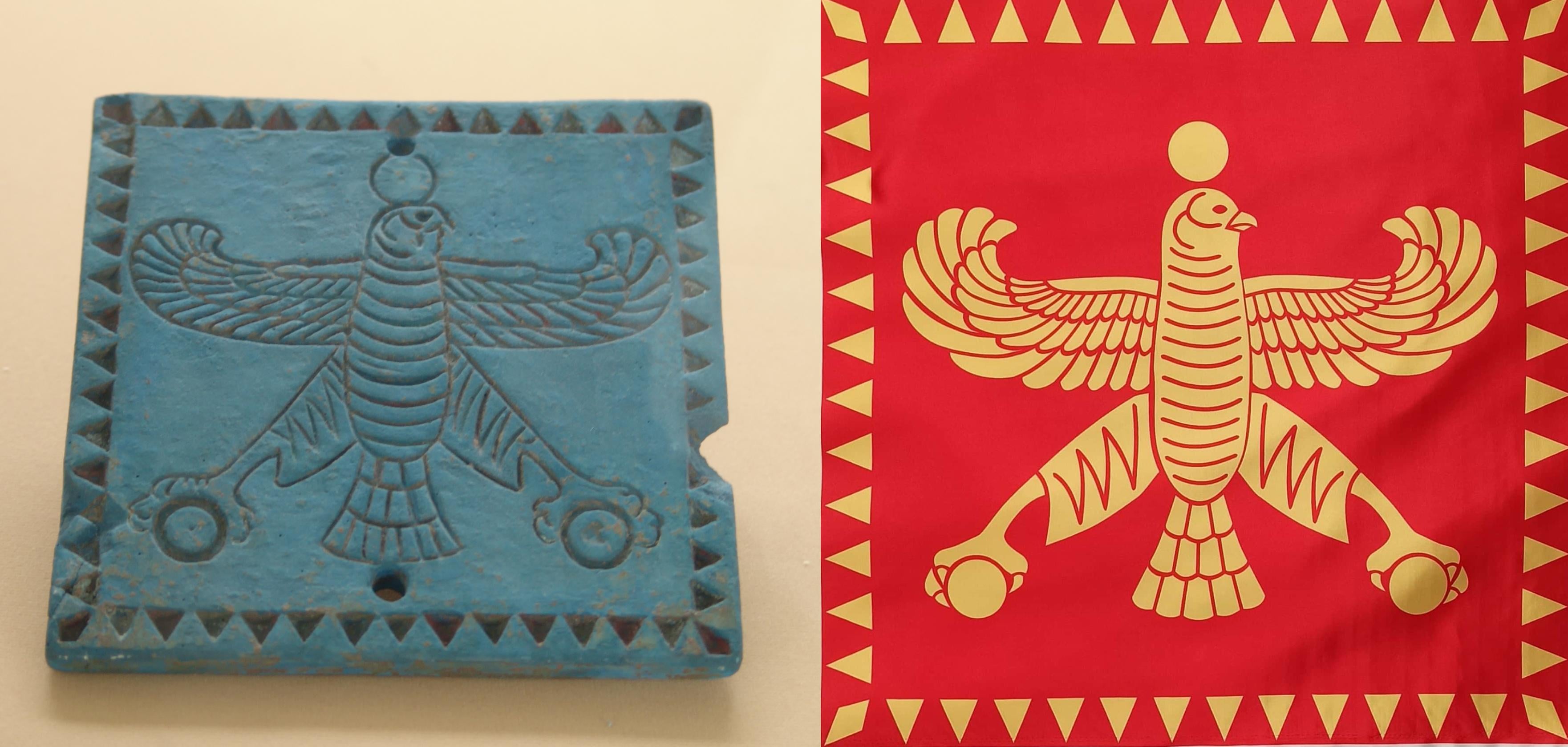
An Achaemenid plaque, the only surviving artifact bearing the emblem of the Empire’s flag. Dating to 550–330 BC, it was discovered in Persepolis and is housed at the National Museum of Iran. [3523×1679]
An Achaemenid plaque, the only surviving artifact bearing the emblem of the Empire’s flag. Dating to 550–330 BC, it was discovered in Persepolis and is housed at the National Museum of Iran. [3523×1679]
It measures 12 by 5 centimeters and was discovered in 1948 at Persepolis, bearing the image of a falcon. The plaque is rendered in Egyptian blue, and its border is decorated with small recessed triangles—thirteen on each side, with four additional ones in the corners. The interior of the triangles is colored green, white, and red.
The bird motif is based on the image of Horus, one of the ancient Egyptian deities. Despite all the Egyptian influence, the design still conveys an Iranian concept, depicting a [Shahbaz ](https://en.wikipedia.org/wiki/Shahbaz)(royal falcon). The two holes at the top and bottom of the tile suggest that the plaque was served as a type of flag or emblem.
No-Passion1127 on
I always wondered how we got the idea that the shahbaz was their banner.

2 Comments
It measures 12 by 5 centimeters and was discovered in 1948 at Persepolis, bearing the image of a falcon. The plaque is rendered in Egyptian blue, and its border is decorated with small recessed triangles—thirteen on each side, with four additional ones in the corners. The interior of the triangles is colored green, white, and red.
The bird motif is based on the image of Horus, one of the ancient Egyptian deities. Despite all the Egyptian influence, the design still conveys an Iranian concept, depicting a [Shahbaz ](https://en.wikipedia.org/wiki/Shahbaz)(royal falcon). The two holes at the top and bottom of the tile suggest that the plaque was served as a type of flag or emblem.
I always wondered how we got the idea that the shahbaz was their banner.
Not it makes sense