
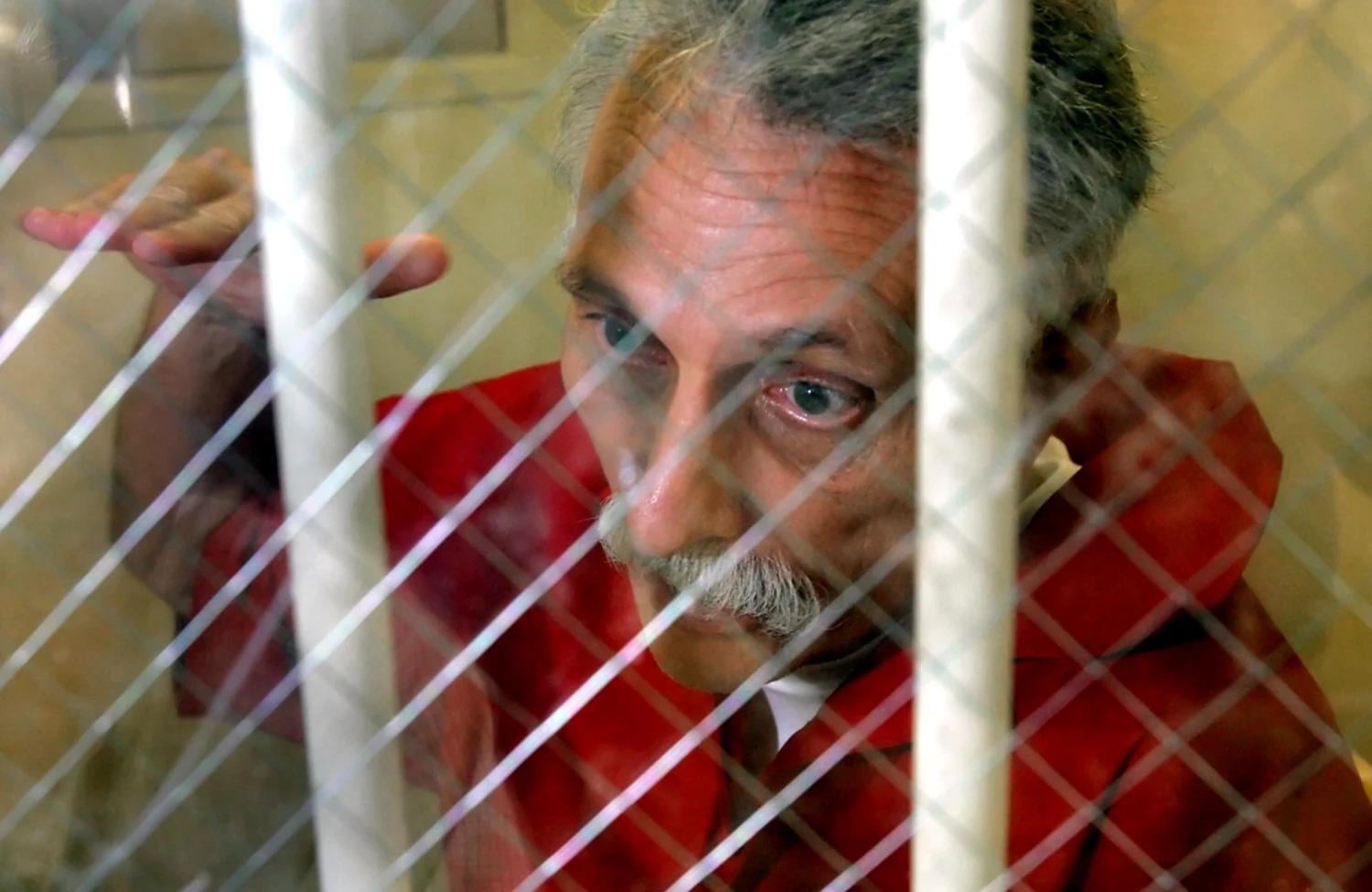
Death row inmate Kenneth Lee Boyd talks to a reporter at Central Prison in Raleigh, North Carolina on November 30, 2005. Boyd, who was put to death three days later for murdering his estranged wife and her father, was the 1,000th person to be executed in the United States since 1976 [1500 x 975].
by lightiggy
2 Comments
[Kenneth Lee Boyd](http://www.clarkprosecutor.org/html/death/US/boyd1000.htm)
>Boyd, 57, did not deny killing Julie Curry Boyd, 36, and her father, 57-year-old Thomas Dillard Curry. But he said he thought he should be sentenced to life in prison, and he didn’t like the milestone his death would mark. “I’d hate to be remembered as that. I don’t like the idea of being picked as a number.”
Personally, I’d rather briefly make global headlines for a day as a number rather than have my face plastered on TV in every state of the country and Canada, being the face of domestic violence for months on end.
Kenneth Boyd was a largely unsympathetic figure who’d committed a crime as old as time itself: murdering a woman for saying no to him. Had he done that and nothing else, Boyd undoubtedly would’ve gotten his wish and received a life sentence. Since life without parole was not a sentencing option in North Carolina at the time of his conviction in 1988, Boyd most likely would’ve been paroled after 25 to 30 years in prison. Some will ask why.
Well, the reasons had nothing to do with Julie Boyd being a woman.
To the contrary, Kenneth Boyd was statistically more likely to be sentenced to death for murdering his estranged wife than her father. Furthermore, his estranged wife, whose life was not any more or less valuable than her father’s life, did not have a protective order against him. Boyd had no prior criminal history and in this hypothetical scenario, would not have committed any additional felonies. He had also shown remorse, having talked with and apologized to his sons from death row. He departed on a somber note.
>”I was just going to ask Kathy, my daughter-in-law, to look after my son and my grandchildren. God bless everybody in here.”
At least one or more of these differences set Boyd apart from both [Elias Syriani](http://www.clarkprosecutor.org/html/death/US/syriani997.htm) and [Alan Matheney](http://www.clarkprosecutor.org/html/death/US/matheney985.htm), who had been executed earlier that year in North Carolina, and Indiana, respectively, both also for murdering women for saying no to them. Syriani was sentenced to death on account of the murder’s brutality and the victim’s protection order against him. Matheney was sentenced to death due to his prior history of terrorizing his ex-wife..
[The story behind the Purple Ribbon](https://www.jacksonville.com/story/news/military/2014/09/24/story-behind-purple-ribbon/15787747007/)
>October is Domestic Violence Awareness Month. Lisa Bianco married Alan Matheney in 1977. They lived in Mishawaka, Indiana in St. Joseph County. They had two daughters. Alan Matheney was described by his mother-in-law, Millie, as every woman’s dream of a son-in-law. He was handsome and charming. However, he was certainly not every woman’s dream of a husband.
>
>For the first seven years of Lisa’s marriage to Alan, Millie had no idea her daughter was living through a nightmare. Lisa divorced Alan in 1985 after enduring eight years of very serious abuse. Shortly after the divorce was finalized, Alan kidnapped their two daughters and fled out of state. Lisa agreed to not press charges if he brought the girls back home. In 1987, Alan was charged with seriously beating and raping Lisa. He plea-bargained to a single felony charge of battery and was sentenced to the Pendleton Reformatory for eight years, with three years suspended.
>
>Lisa began to make a new life for herself. She attended a northern campus of Indiana University. She went to work at the Elkhart Shelter for victims of domestic violence. She told everyone she would have to leave the community when Alan was released from prison. She knew better than anyone how dangerous a man Alan Matheny was.
>
>On March 4, 1989, after serving two years of his sentence, Alan was granted an 8-hour furlough for a trip to Indianapolis. He headed straight for St. Joseph County and parked two doors from Lisa’s home. He kicked in the back door. Lisa fled through the front door. Alan pursued her throughout the neighborhood. When he caught her, he bludgeoned her to death with a shotgun he had stolen from a friend’s home. He hit her so hard, the handle of the shotgun shattered. Lisa’s brutal death took place in front of their 6- and 10-year-old daughters.
>
>There now are victim notification laws, where victims are notified when the perpetrator is being released and the furlough policy was revisited.
It turns out that the title was not an exaggeration. It was an entirely literal statement.
>There also is the purple ribbon – the symbol representing domestic violence awareness – so that we will not forget Lisa. Purple was Lisa’s favorite color and her family and friends tied purple ribbons throughout St. Joseph County as they mourned her tragic and violent death. Today, the purple ribbon continues to be the symbol for domestic violence.
[Lisa Bianco’s mother remembers her](https://www.youtube.com/watch?v=bttYGPsHFms)
>”I still get a lot of letters, emails, and mail from women who say Lisa definitely saved my life,” says Lisa’s mother, Millie Bianco.
>
>What makes this story even more terrifying, is that Lisa knew what her ex-husband was capable of doing. “I’m afraid that if he does get a hold of me again, I’m not going to be able to talk him out of it,” said Lisa Bianco, in an interview before her death. “She asked them for notification anytime that Alan was going to be let out for any reason,” says YWCA President Linda Baechle. “She begged them to tell her. What happened never should have happened.”
Indeed, Lisa Bianco had done everything right. Everything, and she still died.
>”She managed to do as she instructed her clients: Run, get out of the house, run and scream. She just made it to a neighbor’s door when he started swinging the shotgun, the butt, and smashed her head in with such force that the gun butt shattered.”
Her actions only changed the reaction to her death.
[Lisa Bianco murder in 1989 spurred change](https://www.southbendtribune.com/story/news/crime/2014/03/05/lisa-bianco-murder-in-1989-spurred-change/45680317/)
>The horrific slaying on March 4, 1989, reverberated nationally and throughout the state with media outlets reporting on the case. Then- Gov. Evan Bayh quickly shuttered the state prison furlough system and legislators in session that year drafted bills related to the issue. “That is the only thing that we can take away from what is otherwise a horrible event,” Millie Bianco, Lisa’s mother, told The Tribune by phone on Tuesday. “It called attention to the situation.” Officials in the area echoed Millie Bianco’s sentiment, describing the woman’s death as a turning point that spurred laws and awareness. “Every city in America was aware,” said Sareen Lambright Dale, director of the Family Justice Center.
Boyd may not have not been a rapist or a violator of a court order, let alone made national headlines for his crime, but it didn’t matter. He didn’t need to do that to be deemed, as the U.S. Supreme Court put it back in 1976, the “worst of the worst”.
>Boyd and his wife Julie had an extremely stormy marriage for 13 years before Julie left and moved herself and her children in with her father. Boyd repeatedly stalked Julie, once handing one of their sons a bullet and a note to give his mother that said the bullet was intended for her. On March 4, 1988, Boyd drove around with his boys, telling them that he was going to go and kill everyone at his father-in-law’s home. When they arrived, he entered the home and shot and killed both his wife and her father with a .357 Magnum pistol. One of Julie’s sons was pinned under his mother’s body as Boyd continued to fire at her. The child scrambled out from beneath his mom’s body and wriggled under a nearby bed to escape the hail of bullets. When Boyd tried to reload the pistol, another son tried to grab it.
>
>Boyd went to the car, reloaded his gun, came back into the house and called 911, telling the emergency operator, “I’ve shot my wife and her father – come on and get me.”
>
>Then more gunshots can be heard on the 911 recording. Law enforcement officers arrived and as they approached, Boyd came out of the nearby woods with his hands up and surrendered to the officers. Later, after being advised of his rights, Boyd gave a lengthy confession.
>
>”I walked to the back door [of Dillard Curry’s house] and opened it. It was unlocked. As I walked in, I saw a silhouette that I believe was Dillard. It was just like I was in Vietnam. I pulled the gun out and started shooting. I think I shot Dillard one time and he fell. Then I walked past him and into the kitchen and living room area. The whole time I was pointing and shooting. Then I saw another silhouette that I believe was Julie come out of the bedroom. I shot again, probably several times. Then I reloaded my gun. I dropped the empty shell casings onto the floor. As I reloaded, I heard someone groan, Julie I guess. I turned and aimed, shooting again. My only thoughts were to shoot my way out of the house. I kept pointing and shooting at anything that moved. I went back out the same door that I came in, and I saw a big guy pointing a gun at me. I think this was Craig Curry, Julie’s brother. I shot at him three or four times as I was running towards the woods.”
>
>Curry testified that while defendant reloaded his weapon, defendant yelled to him, “Come on up here, Craig. I am going to kill you too.”
At least we know who would play him in any movie made about him…