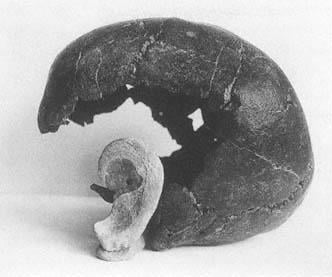
A trepanned neolithic skull of a woman that had a prosthetic ear made from seashell attached, found at Roque d’Aille in France and dates from 3000-2000 BCE. The skull shows evidence the woman had survived the “open brain” operation and gone on to live for many years [332×277]
by Fuckoff555

5 Comments
Where’s the rest of it?
Was the shell grafted to the bone? That’s incredible.
If anyone else is as curious as I was, I found some more information [here](https://publishing.cdlib.org/ucpressebooks/view?docId=ft5j49p06s&chunk.id=d0e103&toc.depth=1&toc.id=d0e103&brand=ucpress).
“But it’s not the relatively commonplace discovery of a Neolithic skull, dating from the third millennium B.C. , that so astonishes us today. It’s not even the fact that the skull, upon examination, turned out to be trepanned. It had been carved open, apparently, with the aid of a rough flint—a primitive crown saw—and the brain had been operated on for an estimated period of three hours. The whole intervention had left a cicatrice nine centimeters long. No, it’s neither the black skull nor the jagged scar that runs like some kind of virulent root about one side of the skull plate that so fascinates us today, but the ear, the artificial ear, that once locked into the left side of that hollow, black receptacle. Carved from a seashell, the *spondylus Graederopus,* its artisan had used the shell’s thick hinge to replicate the earlobe and its shallow vault to imitate the concavity of the ear’s outer whorl. Ironically enough, the external ear is also known, anatomically, as a *concha* .”
Absolutely wild that she survived infection. I wonder if they had some sort of poultice with antibacterial properties, or what.
Wow, that’s really amazing. I’ve seen examples of trepanned skulls with evidence the patient survived and lived for many years before, but never a neolithic prosthetic.