
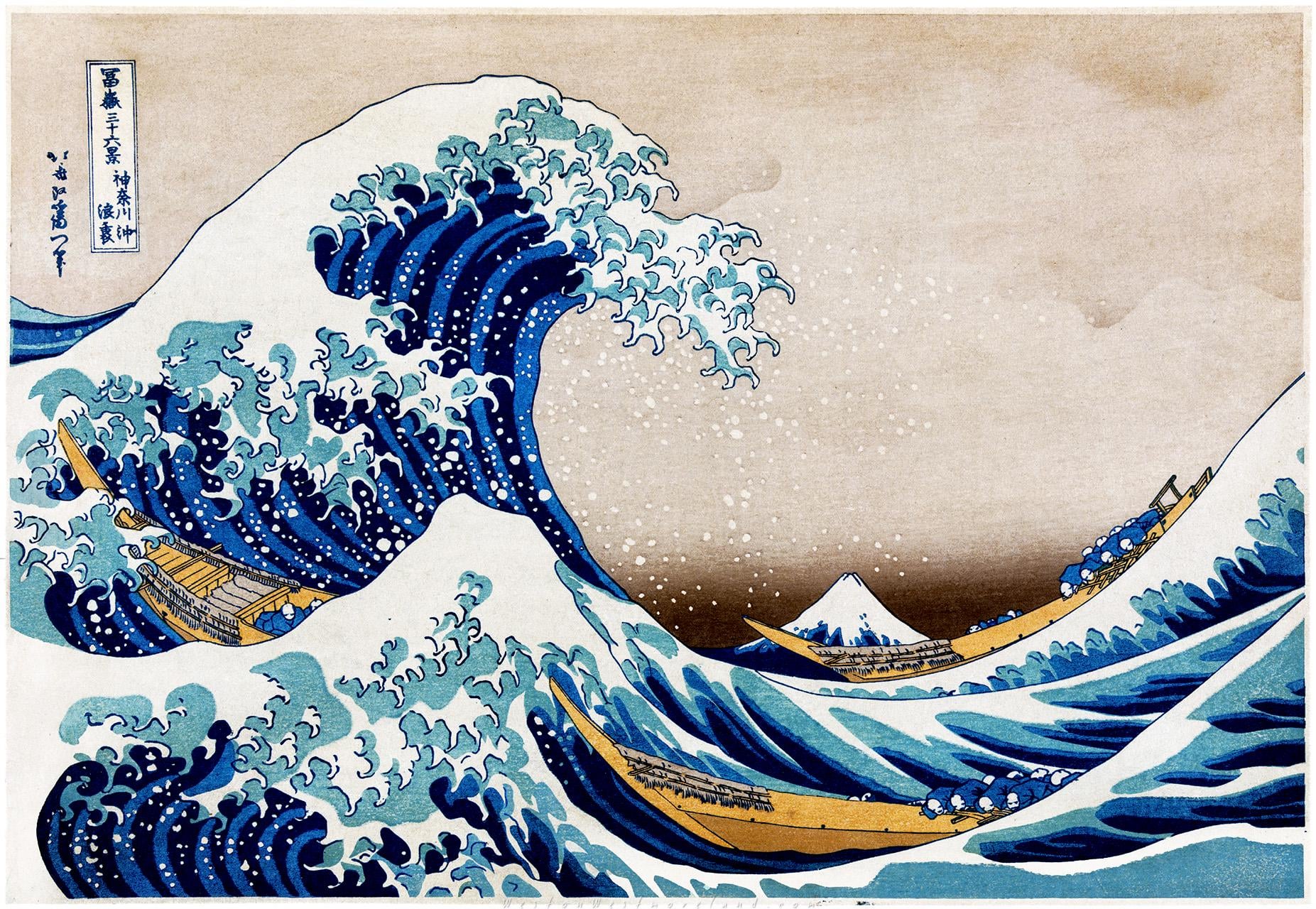
The Great Wave off Kanagawa, an Ukiyo-e painting, a woodblock print, by Japanese artist Hokusai. Published around 1830 as the first in the series “36 Views of Mount Fuji”, it is Hokusai’s most famous work and is often considered the most recognizable work of Japanese art in the world… [1563×1080]
by WestonWestmoreland
1 Comment
…The image depicts an enormous wave in the Sagami Bay (Kanagawa Prefecture) with Mount Fuji rising in the background. Sometimes assumed to be a tsunami, the wave is more likely to be a large rogue wave.
Ukiyo-e is a Japanese printmaking technique which flourished in the 17th through 19th centuries. Its artists produced woodblock prints and paintings of subjects including female beauties; kabuki actors and sumo wrestlers; scenes from history and folk tales; travel scenes and landscapes; Japanese flora and fauna; and erotica. The term ukiyo-e translates as “picture(s) of the “floating world”.
The earliest ukiyo-e works, Hishikawa Moronobu’s paintings and monochromatic prints of women, emerged in the 1670s. Color prints were introduced gradually, and at first were only used for special commissions. By the 1740s artists such as Okumura Masanobu used multiple woodblocks to print areas of color. In the 1760s the success of Suzuki Harunobu’s “brocade prints” led to full-color production becoming standard, with ten or more blocks used to create each print. Some ukiyo-e artists specialized in creating paintings, but most works were prints.
Artists rarely carved their own woodblocks; production was divided between the artist, who designed the prints; the carver, who cut the woodblocks; the printer, who inked and pressed the woodblocks onto hand-made paper; and the publisher who financed, promoted, and distributed the works. As printing was done by hand, printers were able to achieve effects impractical with machines, such as the blending or gradation of colors on the printing block.[
Woodblock printing in Japan was used in single art sheets and also for book printing during the Edo period (1603–1868). Like Western wood-cut printmaking, it used water-based inks instead of oil-based.
The great wave is generally described as a monstrous or ghostly wave like a white skeleton threatening the fishermen with its “claws” of foam. This interpretation of the work recalls Hokusai’s mastery of Japanese fantasy. An examination of the wave on the left side reveals many more “claws” that are ready to seize the fishermen behind the white foam strip. This image recalls many of Hokusai’s previous works which more explicitly depict supernatural themes. The wave’s silhouette resembles that of a dragon, which the author frequently depicts, even on Mount Fuji.
One of the interpretations of the picture represents traditional Japanese culture through the fishermen and the foreign cultures engulfing and drowning Japanese traditions through the Great wave. The end of times as they were… But that is just one interpretation.
My apologies for inaccuracies and mistakes.