
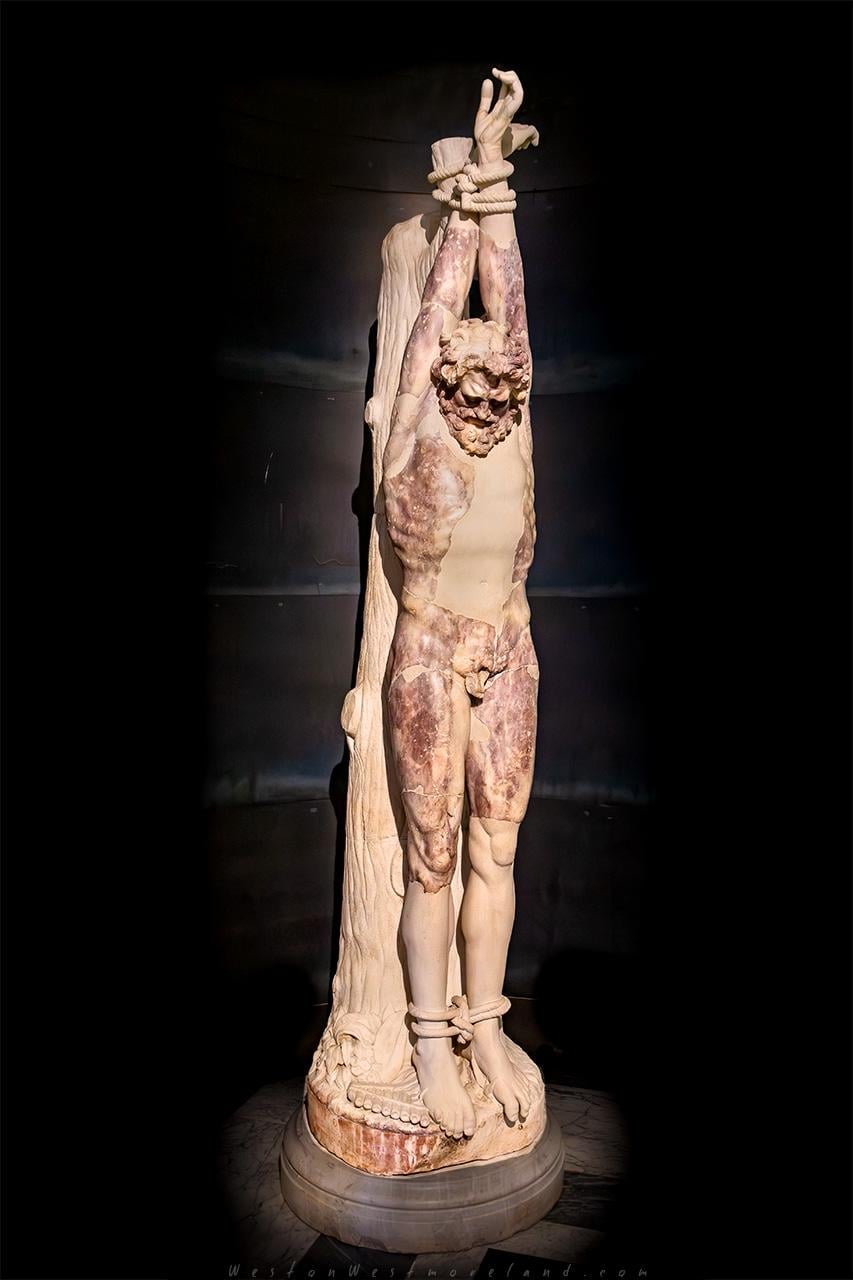
Marsylas flayed, a 1st-2nd century AD Roman copy of a Greek original from the 2nd century BC, found at the Horti Maecenatiani. The choice of the marble, known as pavonazzetto, renders dramatically the livid colors of the tortured body and gives a startlingly lifelike impression… [1280×853] [OC]
by WestonWestmoreland
1 Comment
…The statue represents the Silen Marsyas (an ancient rustic river god) bound by the wrists and ankles to a tree trunk and flayed alive.
Pindar tells of how the goddess Athena, once the aulos was invented, threw the instrument away, annoyed that it deformed her cheeks when she played it. As soon as Athena left, Marsyas picked up the instrument and began playing it with such grace that all the people were enchanted, convinced that his talent was greater even than Apollo’s.
Marsyas, proud, did not contradict them, until one day his fame reached Apollo himself, who immediately challenged him (according to other versions, it was Marsyas himself who challenged him). The winner, decreed by the Muses, judges of the contest, would be granted the right to do whatever he wanted with the contender.
After the first test, however, the Muses awarded a draw, which Apollo did not like. So the god invited Marsyas to overturn his instrument and play: Apollo, logically, managed to overturn the lyre and play it, but Marsyas could not do the same with his flute and recognized Apollo as the winner (according to another version, Apollo proposed to elect a winner by singing and playing at the same time, so that only he, who had a stringed instrument, would succeed). The god, then, decided to punish Marsyas for his pride and, binding him to a tree, flayed him alive.
The figure is shown nude, with the body stretched and twisted in pain, the facial features contorted, and his anatomy rendered with marked muscular tension and pathos. The choice of this violet-veined marble, known as pavonazzetto, reproduces dramatically the livid colors of the Silen’s tortured body and gives a startlingly lifelike impression: it seems Marsyas is torn from his skin before our eyes. A surprisingly gruesome use of marble color.
The Capitoline Marsyas is an early Roman imperial copy of a Late Hellenistic Greek original of the 2nd century BCE. Ancient descriptions and surviving parallels indicate that versions existed in both white and reddish marble, the latter probably chosen to heighten the sense of bloody flaying.
In antiquity this Marsyas belonged to a sculptural group: at his feet there was a kneeling Scythian executioner sharpening a knife, while Apollo sat nearby presiding over the punishment. The subject embodied the mythic theme of *hubris*—Marsyas daring to challenge a god—and its brutal divine retribution, a moral that Roman viewers would have recognized instantly.
The statue has been reassembled from various fragments. The lower part of the legs, the hands and part of the forearms are restorations. It was Found at the Auditorium of Maecenas, in the Horti Maecenatiani, the gardens on the Esquiline associated with Maecenas.
My apologies for inaccuracies and mistakes.