
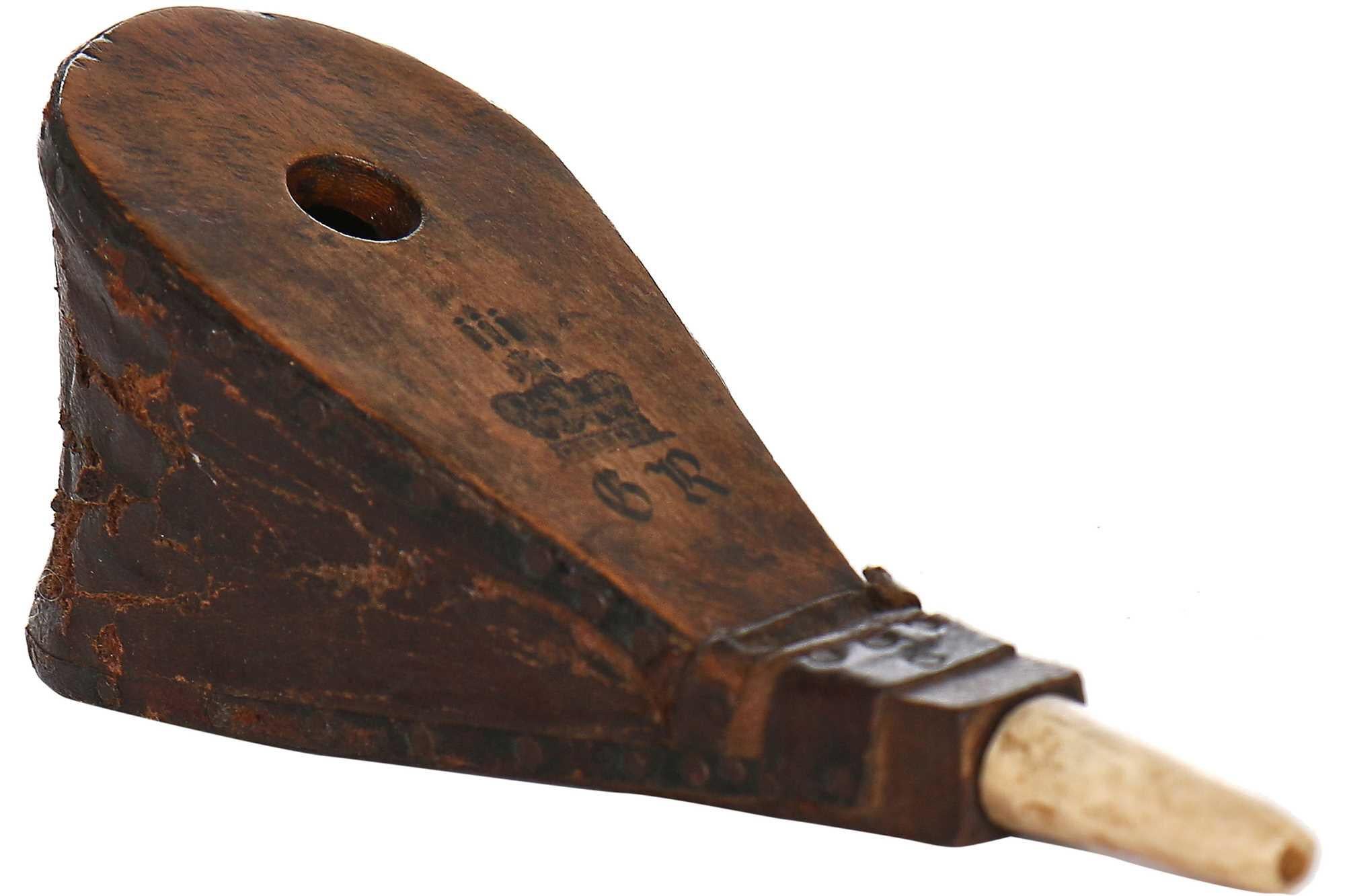
A wig-powder bellows bearing the cypher of King George III, circa 1775. A wig-powder bellows was a handheld tool used to apply powder to a wig or hair in the 18th century. It worked by pressing the bellows together to force a cloud of powder, typically made from scented starch. [2000 x 1333]
by Circes_season
1 Comment
“[Provenance](https://www.kerrytaylorauctions.com/auction/lot/lot-31—a-rare-pair-of-wig-powder-bellows-bearing-the-cypher-of-king-george-iii-circa-1775/?lot=28567&sd=1): from a descendant of the House of Bourbon.
During the 18th century the fashion for wigs was at its height. Perukes (powdered wigs) were teased into fantastical shapes, the more expensive examples being made from real human hair. They became something of a status symbol, an everyday wig cost about 25 shillings (a week’s pay for a common labourer in London), whereas a large elaborate example could be as much as 800 shillings – hence the name ‘bigwig’ was coined. At a time when syphilis was rife (causing balding) and lice commonplace – the wig solved both problems – the insects inhabited the wigs rather than the scalps of the wearer. The wig powder made from finely ground starch (poorer folk used flour), as well as being a dye (grey and white hair being deemed the most elegant), it was also aromatic (orange and lavender being popular) and contained excellent de-lousing properties. In any case the head was preferably shaved, for the peruke to fit properly. If the wig became infested it could be sent to the wig maker for boiling, before being re-curled, re-powdered and returned. Powdering was something of a palaver – the wig or hair first being greased or oiled so that the powder would stick, a powdering cape having first been placed over the shoulders to prevent clothes being ruined. The hairdresser then stood as far back as possible whilst the powder was puffed from the little bellows. A hole in the top (usually sealed by a cork) was used to fill the bellows with powder. It was a messy business.
The first tax on hair powder was a stamp duty applied in 1786 and applied to packets of hair powder for wigs and on perfumes and cosmetics. The tax was set at 1d on packets costing up to 8d, rising to 1s on items over 5s. In 1795 William Pitt the Younger (ironically a Whig) made wig owning even more onerous. Desperate to raise funds for the war with France, the government doubled the tax on wig powder as well as introduced a regulation making the wig powder user apply for a licence which cost a guinea. For those willing to pay the tax, such as barristers or physicians, the Whigs began calling them “guinea pigs” This name-calling in turn resulted in the London Times satirizing the closely-cropped Whigs.
‘With respect to the manipulation of the hair, it is singular to observe that in 1795 a club was described by ‘The Times’ as having been formed in Lambeth called ‘The Crop Club,’ every member of which, on his entrance, is obliged to have his head docked as close as the Duke of Bridgewater’s old bay coach-horses. This assemblage is instituted for the purpose of opposing, or rather evading, the tax on powdered heads.’
However, not everyone was required to purchase a license. Notable exemptions included: the Royal Family and their servants, clergymen with an income of under £100 a year, various ranks in the military, yeomanry, mariners, engineers. A nobleman could also buy a single license to cover the use of his household servants.
Wigs and powdering began to fall from favour in the late 18th century. French citizens ousted the peruke during the revolution and in England there was a bread shortage so to use starch or flour for mere adornment was deemed frivolous. By the early 19th century the fashion changed n favour of shorter, natural hair and wigs tended to be worn by certain professions and just by the elderly, reluctant to relinquish the fashion of their youth.”