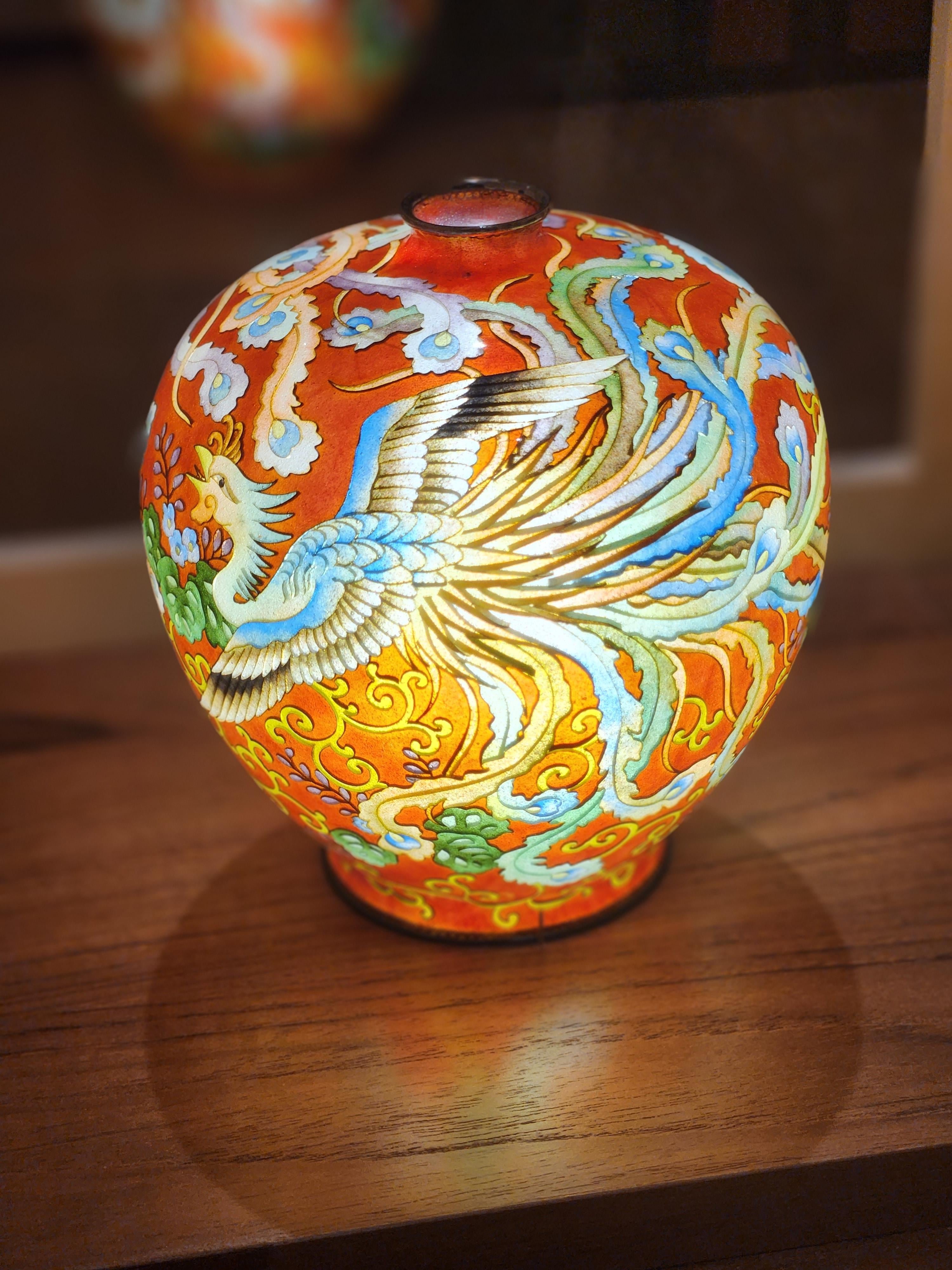
The technique of shotai shippō, or plique-à-jour, is an example of the modern innovations of cloisonné makers during the Meiji period, here used to enliven historical and natural motifs on works of art that reflect the new technologies of Meiji Japan, including new forms of lighting. Like traditional cloisonné, shotai requires a copper base, covered bent wires, and colored enamels; for plique- à-jour, however, this copper base is etched away, essentially dissolved with an acidic solution, resulting in a translucent, seemingly bodiless vessel, ideally suited for a decorative lamp globe. Created for a gas lamp, the globe bears a design of phoenixes intertwined with decorative paulownia crests, the symbol of the Meiji government. Throughout the design the colors are mixed, as seen in the soft shading and gradients of the feathers of the sacred birds, implying the use of musen or “wireless” enameling, another Meiji period invention.]

1 Comment
[display description](https://i.ibb.co/d0Xbfkzv/20231020-155702.jpg)
[Hattori Tadasaburō (d. 1939)
Lamp Globe with Phoenix, ca. 1910
Plique-à-jour enamels
Private collection
The technique of shotai shippō, or plique-à-jour, is an example of the modern innovations of cloisonné makers during the Meiji period, here used to enliven historical and natural motifs on works of art that reflect the new technologies of Meiji Japan, including new forms of lighting. Like traditional cloisonné, shotai requires a copper base, covered bent wires, and colored enamels; for plique- à-jour, however, this copper base is etched away, essentially dissolved with an acidic solution, resulting in a translucent, seemingly bodiless vessel, ideally suited for a decorative lamp globe. Created for a gas lamp, the globe bears a design of phoenixes intertwined with decorative paulownia crests, the symbol of the Meiji government. Throughout the design the colors are mixed, as seen in the soft shading and gradients of the feathers of the sacred birds, implying the use of musen or “wireless” enameling, another Meiji period invention.]