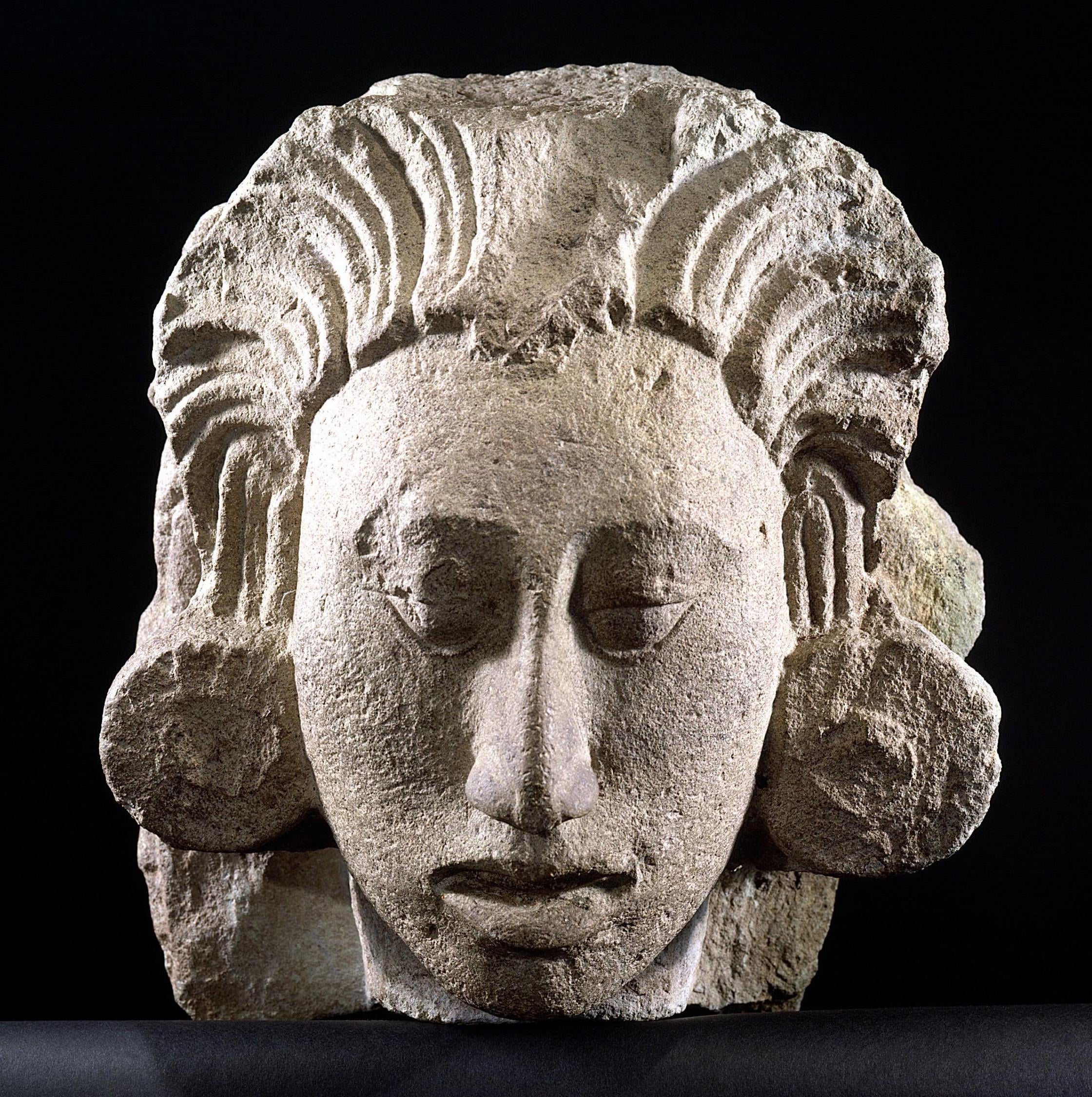
[Museum](https://museum.doaks.org/objects-1/info/22753). Maize was sacred for the Maya, whose livelihood depended on its successful cultivation. Every effort, both physical and ritual, was made to ensure conditions favorable for its production. A symbol of fruitfulness and prosperity, maize was often commemorated in art in the form of a beautiful young man. This head of personified maize was originally part of a figure carved in the round from the waist up. It represents maize as a well-proportioned youth with a long profile, close-set eyes, a soft facial contour, and an elongated and flattened forehead. He wears large earspools, and his long hair is combed back away from his face, suggesting maize leaves similar to the ones that once adorned the top of his head. A complete figure currently in the British Museum shows him richly adorned with jewelry and gesturing with his hands. He embodies the Maya ideal of grace and beauty, which Maya elites sought to emulate in their own portraits and in life, through such practices as cranial flattening to mimic the shape of a corn cob, dental modification, and the use of sumptuous attire and courtly manners.
This figure once ornamented the upper façade of a temple at Copan. Built by the city’s thirteenth ruler, Waxaklajun Ub’ah K’awil (who reigned 695-738), the temple embodied the generative aspects of the world. A chamber inside it was the symbolic center of the Maya cosmos. Around it, the exterior of the building was decorated with masks of the earth monster, representing the animated earth. At the top of the temple, maize figures sprouted out of the animated earth, possibly symbolizing the result of rituals performed within, and promising fertility, productivity, and abundance to the city’s population.

1 Comment
[Museum](https://museum.doaks.org/objects-1/info/22753). Maize was sacred for the Maya, whose livelihood depended on its successful cultivation. Every effort, both physical and ritual, was made to ensure conditions favorable for its production. A symbol of fruitfulness and prosperity, maize was often commemorated in art in the form of a beautiful young man. This head of personified maize was originally part of a figure carved in the round from the waist up. It represents maize as a well-proportioned youth with a long profile, close-set eyes, a soft facial contour, and an elongated and flattened forehead. He wears large earspools, and his long hair is combed back away from his face, suggesting maize leaves similar to the ones that once adorned the top of his head. A complete figure currently in the British Museum shows him richly adorned with jewelry and gesturing with his hands. He embodies the Maya ideal of grace and beauty, which Maya elites sought to emulate in their own portraits and in life, through such practices as cranial flattening to mimic the shape of a corn cob, dental modification, and the use of sumptuous attire and courtly manners.
This figure once ornamented the upper façade of a temple at Copan. Built by the city’s thirteenth ruler, Waxaklajun Ub’ah K’awil (who reigned 695-738), the temple embodied the generative aspects of the world. A chamber inside it was the symbolic center of the Maya cosmos. Around it, the exterior of the building was decorated with masks of the earth monster, representing the animated earth. At the top of the temple, maize figures sprouted out of the animated earth, possibly symbolizing the result of rituals performed within, and promising fertility, productivity, and abundance to the city’s population.