
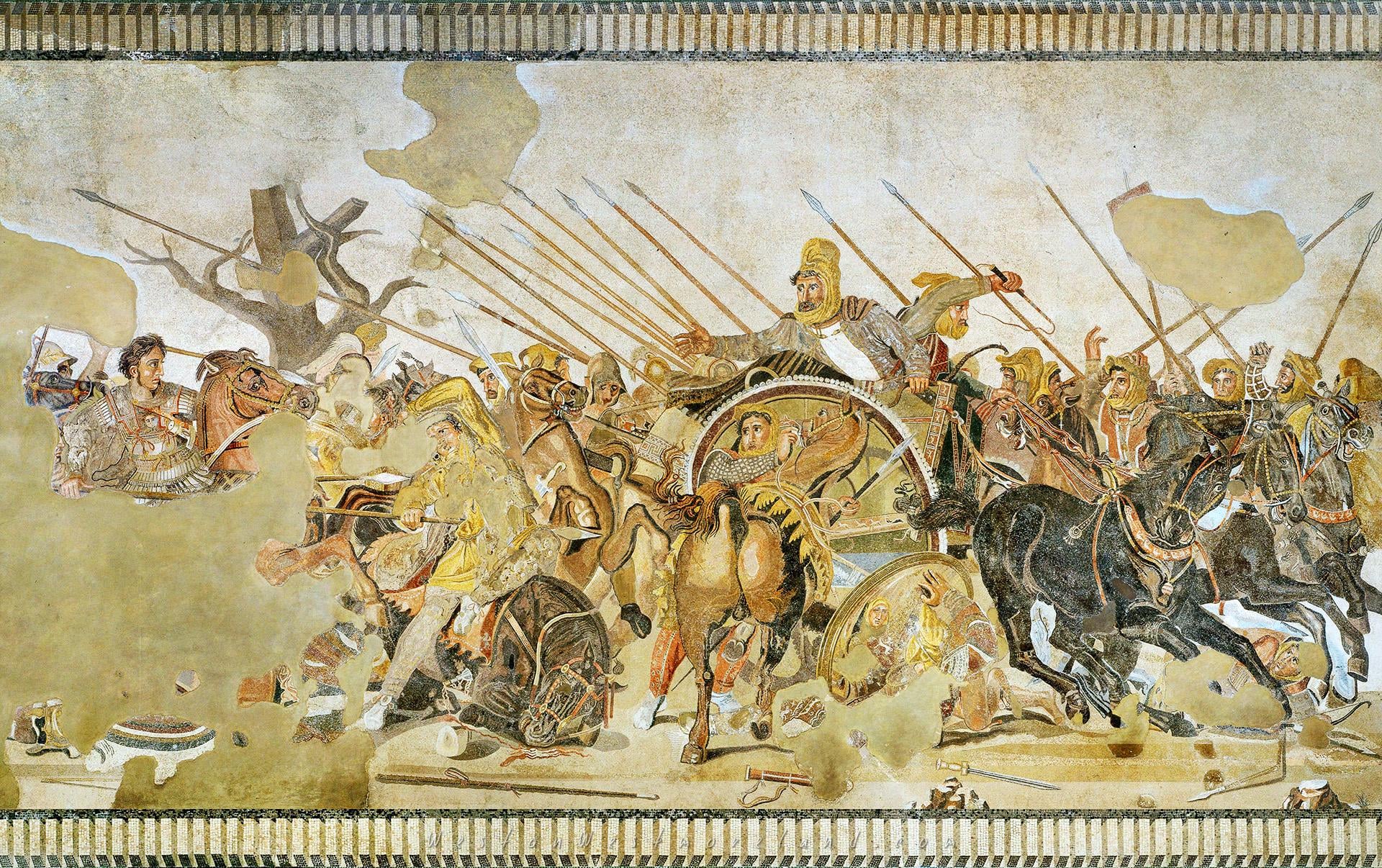
Alexander Mosaic, c. 100 B.C.E. Roman copy of a lost Greek painting, House of the Faun, Pompeii. This monumental Mosaic (8 ft 11 in × 16 ft 10 in) is made up of about 1.5 million minute tesserae. I found a wonderful explanation of the scene and its dramatic depiction. Keep on reading… [1920×1206]
by WestonWestmoreland
3 Comments
…A general (Alexander the Great) charges on horseback across the field of battle. His spear pierces a soldier’s torso, who recoils in pain and shock on the verge of falling over the dead body of a horse behind him. On the other side of the battlefield, a charioteer scrambles frantically to turn his horses around, trampling bodies beneath their hooves in an attempt to get the opposing general (Darius) to safety. These are just some of the intense scenes depicted in the Alexander Mosaic.
This scene is identified as the Battle of Issus, which took place on November 5, 333 B.C.E. in modern-day Turkey . It confronted the Hellenic League forces of Alexander and the Achaemenid Persian forces of Darius III—a struggle which would ultimately result in a victory for Alexander.
The mosaic is made up of approximately 1.5 million tesserae, which are small, cubed pieces of glass or stones cut into shape. The mostly earth-colored stones—brought from Italy, Greece, Spain and Tunisia— are remarkably tiny and used to emphasize the details of the scene. They are laid down in *opus vermiculatum*, a technique is identified as “worm-like” due to the curved lines of tesserae placed to emphasize features.
The scene once covered the entire floor of a room located between the two peristyle gardens of the large and grand House of the Faun in Pompeii. The mosaic survives in such good condition because it was protected by layers of ash from the 79 C.E. volcanic eruption of Mount Vesuvius until its rediscovery in 1831.
Though parts of the mosaic have been damaged in the more than two millennia since its creation, much of the dramatic scene is still visible today.
On the left side of the mosaic, Alexander charges on Bucephalus(his horse) against the Persian army, led by Darius III, located on the right side of the mosaic, standing atop his chariot. Fully armored, but bare-headed, Alexander’s gaze is focused on Darius while he pierces the soldier. His hair flies out behind him from the force of his forward momentum. His army follows closely as they advance towards the spear-carrying soldiers of the Persian army. In his right hand he holds a sarissa, a type of long spear invented by his father (Philip II, the former King of Macedon), which became an essential tool of Alexander and his forces as they conquered his empire.
Before Alexander’s spear can make contact with Darius, a man, often identified as one of Darius’ kinsmen, jumps in front of the spear and takes the blow meant for his king. Behind Darius and facing in the opposite direction, the charioteer frantically tries to wheel the chariot around. Holding the reins tightly with his left hand, he raises a whip in his right hand to spur the horses to move faster through the crowd of soldiers across a battlefield that is strewn with blood, bodies, and abandoned weapons. The shock of this moment is reflected in Darius’ face. The artist succeeds in capturing the devastation and fear in Darius’ facial expression. He desperately reaches out in vain towards his dying kinsman, looking towards Alexander.
The artist captures the frenzied movements and fearful eyes of the horses as they trample soldiers and Darius flees from the battle, eyes still fixed on Alexander. Although Alexander wins this battle, Darius is the tallest figure in the mosaic, elevated by the chariot on which he stands and puts his grief on prominent display.
This mosaic is remarkable not just for representing this significant battle, but also for the level of detail and naturalism it displays. All of the figures from humans to horses are rendered with a sense of three-dimensional, naturalistic modeling. By the late classical period and into the Hellenistic period, representations of figures had shifted from classical idealism to humanistic depictions which emphasized realistic anatomy and emotion, as is evident here… (continues in replay)
Its a little miracle that the most important figures, those of Darius and Alexander, survive when other parts of the mosaic have been lost.
Extra-extra fun fact. It is believed that the visible damage shows us how the mosaic would have been looked at. The host of the home where this was held would have treated this as primary entertainment for invited guests and would have been proud to show it off. The concentration of damage around key parts of the scene suggest the damage is where guests would have stood to examine the scene. So the ring around Alexander shows where people would have regularly gathered for a closer look, and the damage on the tree above would be where the host would have repeatedly stood in talking about the artwork to the guests before him. Similar type of damage is focused around the trampled soldier’s reflection, another key part of the scene that would have been examined closely by visitors.