
Hello again, everyone!
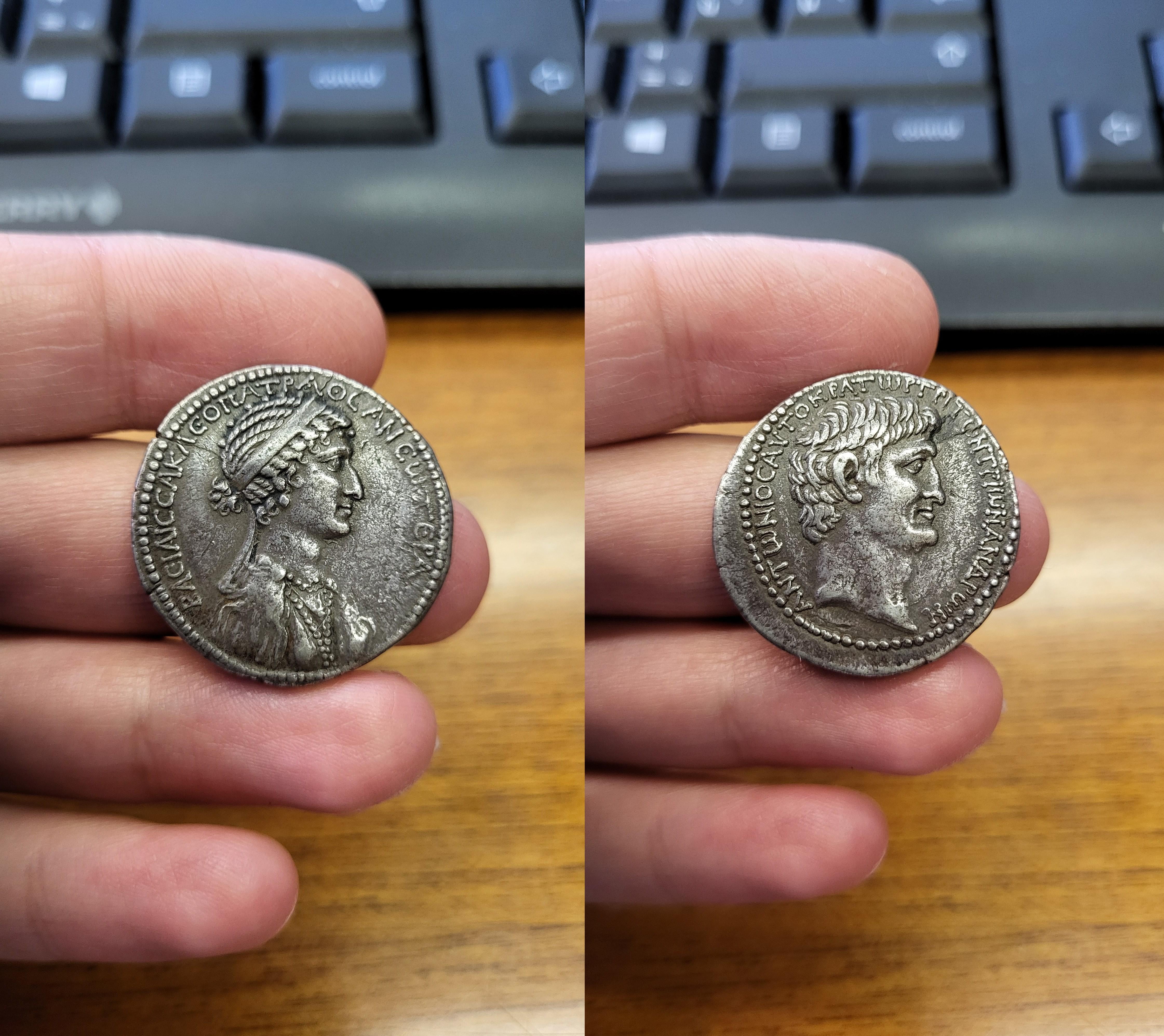
With a slight delay, we are back with another coin from our collection. For this post, we’re featuring an iconic piece – a tetradrachm of Cleopatra, showing both herself and her lover, Mark Antony. One of history’s most famed (or infamous) couples needs little introduction.
In 41 BCE, Cleopatra travelled in grand style to Tarsos, where Antony was residing after establishing himself in the East following the defeat of Caesar’s assassins. Both had something to gain from one another: the triumvir opened up the possibility of restoring the ailing Ptolemaic Empire, while the queen could prove a valuable ally in Rome’s conflict with the Parthians. Political expedience soon turned into love, however, and by the summer of 40 BCE the couple’s first children, a pair of twins, were born.
That same year, the Parthians invaded Rome’s eastern territories, assisted by the Roman general Q. Labienus. Ancient authors portray Antony as indecisive, distracted by the pleasures of courtly life in Alexandria and Cleopatra’s presence. The Parthian advance was narrowly checked in Asia Minor by Antony’s general Publius Ventidius, who managed to drive the Parthians out of Roman territory in 38 BCE. With the Parthian threat still looming on the horizon, Antony began planning a large-scale invasion of Parthia. This naturally required substantial funds, and Cleopatra also contributed.
This coin was probably struck in Antioch in 36 BCE to pay for that campaign. The obverse features the Ptolemaic queen, diademed, a ruler in her own right. The legend reads “BACIΛICCA KΛЄOΠATPA ΘЄA NЄⲰTЄPA” — “Queen Cleopatra, the Newer (or Younger) Goddess.” While it may seem surprising, Ptolemaic rulers had a long tradition of divine associations, and Cleopatra’s father, Ptolemy XII, had styled himself “the New Dionysos.” Antony’s legend, conversely, is far more restrained, reading “ANTⲰNIOC AYTOKPATⲰP TRITON TPIⲰN ANΔPⲰN” — “Antony, imperator for the third time, one of the triumvirs.”
What makes this coin (28 mm, 15.28 g), which comes from the collection of Lucien de Hirsch (1856–1887), so exceptional is that the legends are complete. Most examples are struck slightly off-center, causing part of the legend to be lost. It also features two strong portraits – Cleopatra’s slightly virile features may belie her status as a beauty icon today, but ancient authors tell us her charm lay more in her wit and personality than in her physical beauty.
While this issue was once considered very rare, the market has recently become somewhat flooded with examples, likely due to the dispersal of a hoard. Still, this specimen stands apart – a fitting monument to one of history’s most tragic couples.
by KBRCoinCabinet