
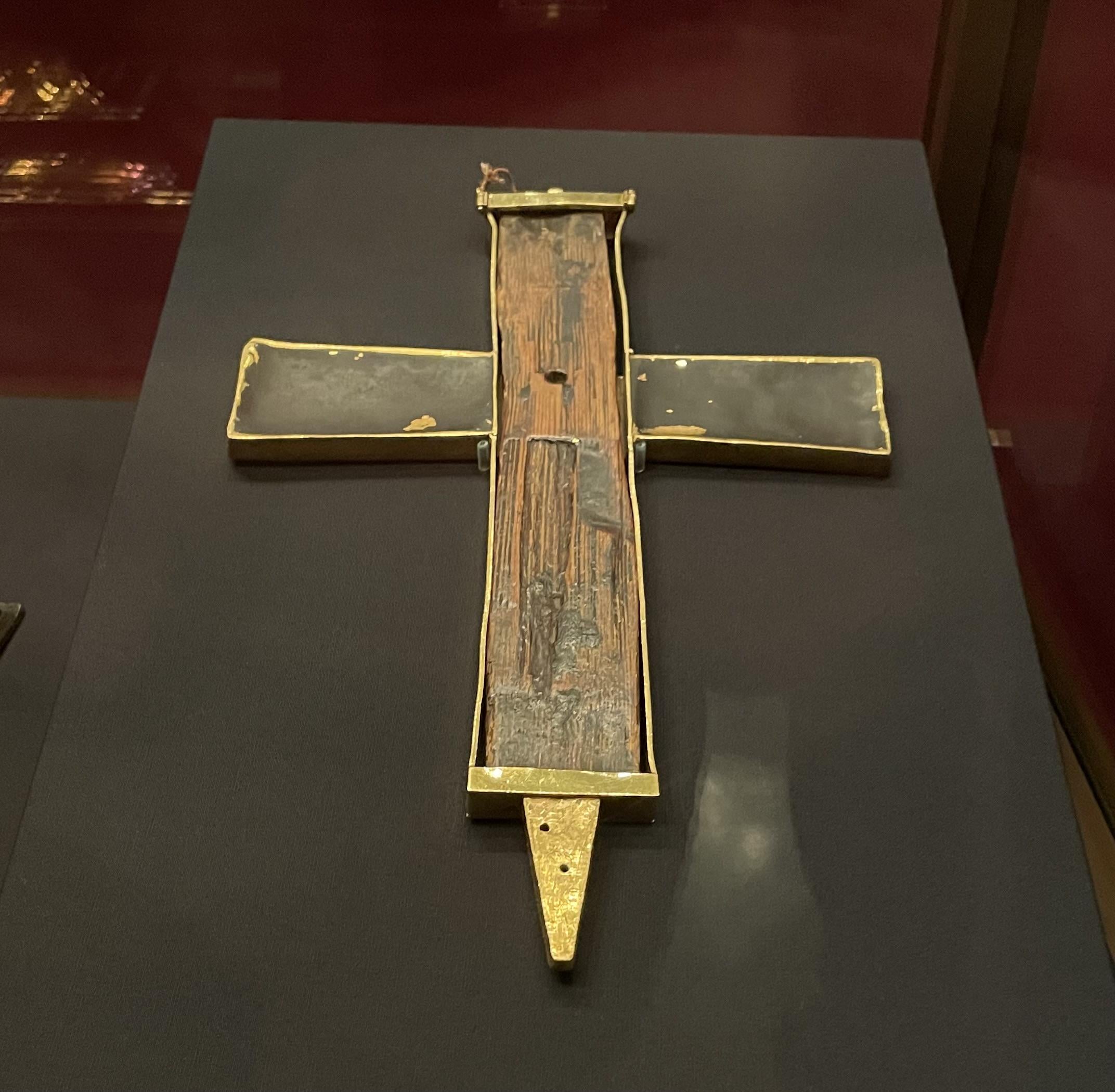
From 'Masterpieces of the Imperial Secular Treasury Vienna':
From the time of Constantine, relics that could be connected with the earthly life and Passion of Christ were accorded special veneration. The most precious substance that Jesus had left behind from his life on earth was considered to be his own redeeming blood, which must have soaked into the wooden cross on which he died. Relics of the cross were thus considered to be incomparably precious, and almost all of them were in the possession of the Byzantine emperor. The ruler believed that they protected him and raised his legitimacy above all doubt. Thus it was vitally important to the Western emperor that he also acquire such relics of the Passion.
There is no tradition for the exact time when the "Particle of the Cross" entered the imperial treasury. The latest possible date, however, is the time when the Imperial Cross (Cat. No. 2) was created, because the compartment in its lower shaft was made to hold the Particle. It may thus be the gift sent by Emperor Romanus III Argyrus to Conrad II when the latter's legation returned from Constantinople in 1029.
In any case, the "Particle of the Cross" was incomparable, not only because of its unusual size but also because of the nail-hole in the centre. It thus provided the Roman emperor with a relic that made him the equal of his Byzantine counterpart, and it was stored together with the Holy Lance (Cat. No. 3) in the Imperial Cross. Emperor Charles IV (reigned 1346-1378) had the reliquary of partially blackened gold made in the form of a processional cross. It is of very simple design so as not to detract from the veneration of the holy wood.
by 357Loki