
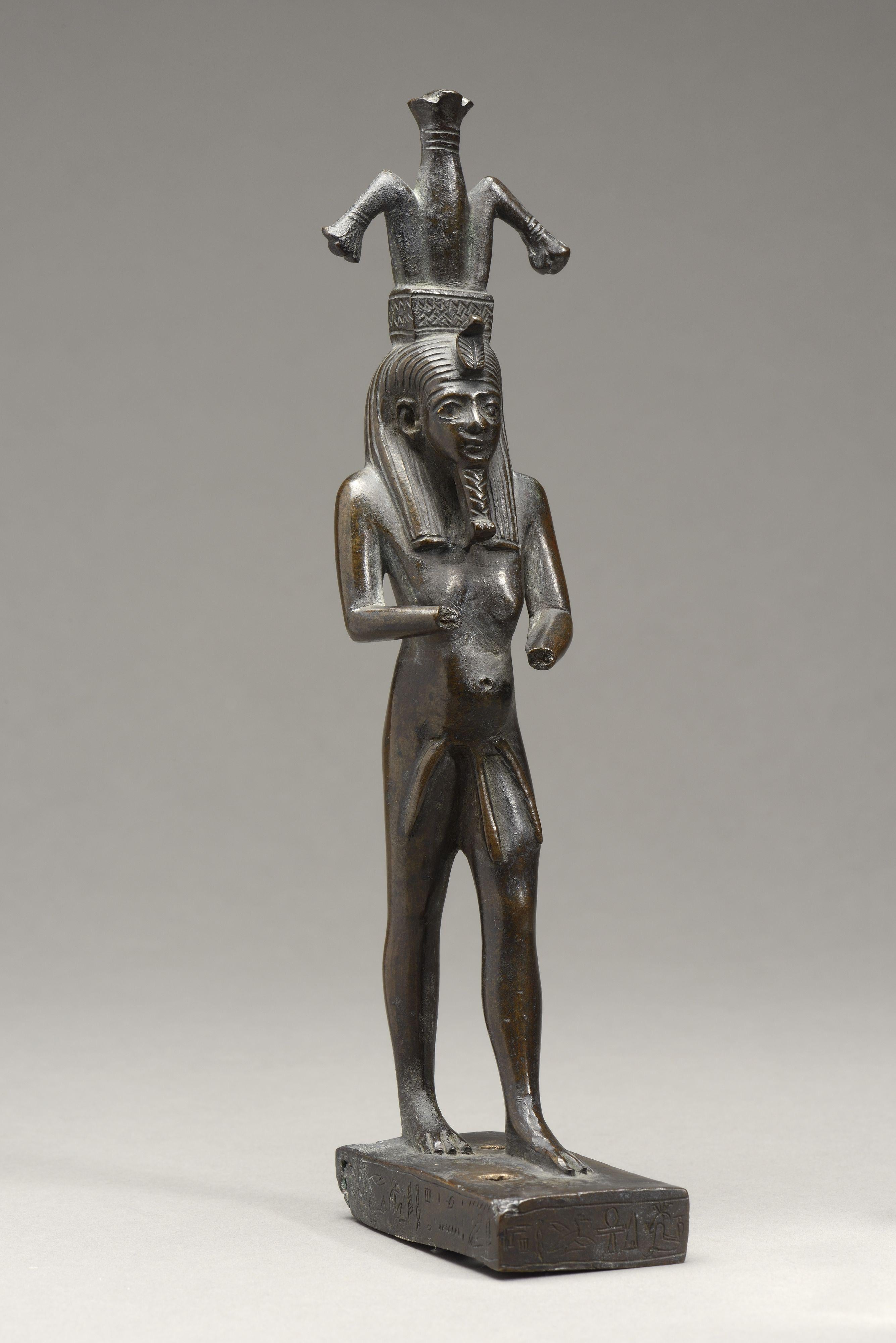
The Nile God Hapi
INFORMATION SUR L’ARTISTE
EGYPT
Date de l’œuvre libre
vers 664-343 avant J.-C.
Egypte, Nil divin-Hâpy, XXVIe-XXXe dynastie. Égypte,
Nil divin-Hâpy, Basse Epoque.
Image © Lyon MBA – Photo Alain Basset
Contenu
Hapi, a personification of the flooding of the Nile, is associated with fecundity and prosperity. For the ancient Egyptians, the Nile held the promise of miraculous fertility, and was thought to be a resurgence of the primordial ocean.
This statue, which is of exceptional artistic quality, depicts the divinity standing, dressed only in a loincloth. His physical appearance evokes his qualities: the rounded stomach and pendulous breasts symbolise fecundity, while the long arms would probably have originally carried a tray loaded with food, an image of the riches offered up by the earth after the flood. His wig is decorated with a cobra on the front and topped by three plants from the northern swamps which represent the river. A dedication is inscribed around the base: May Hapi give life to Tjahâpyimou, son of Ptahirdisou.
Depictions of Hapi, who is often featured on the bases of temples where he is shown bringing offerings to the shrine, are rarely found in statue form. This statuette, listed in 1761 in the collection belonging to President F. X. Bon de Saint-Hilaire in Montpellier, is one of the oldest Egyptian artefacts to be brought to France.
Egypt
Late Period, Dynasties 26 to 30, circa 664-343 B.C.
Bronze
H. 20.8; W. 5; D. 7.3 cm
Acquired in 1810
Inv. H 1517
Museum of Fine Arts of Lyon
by Handicapped-007