
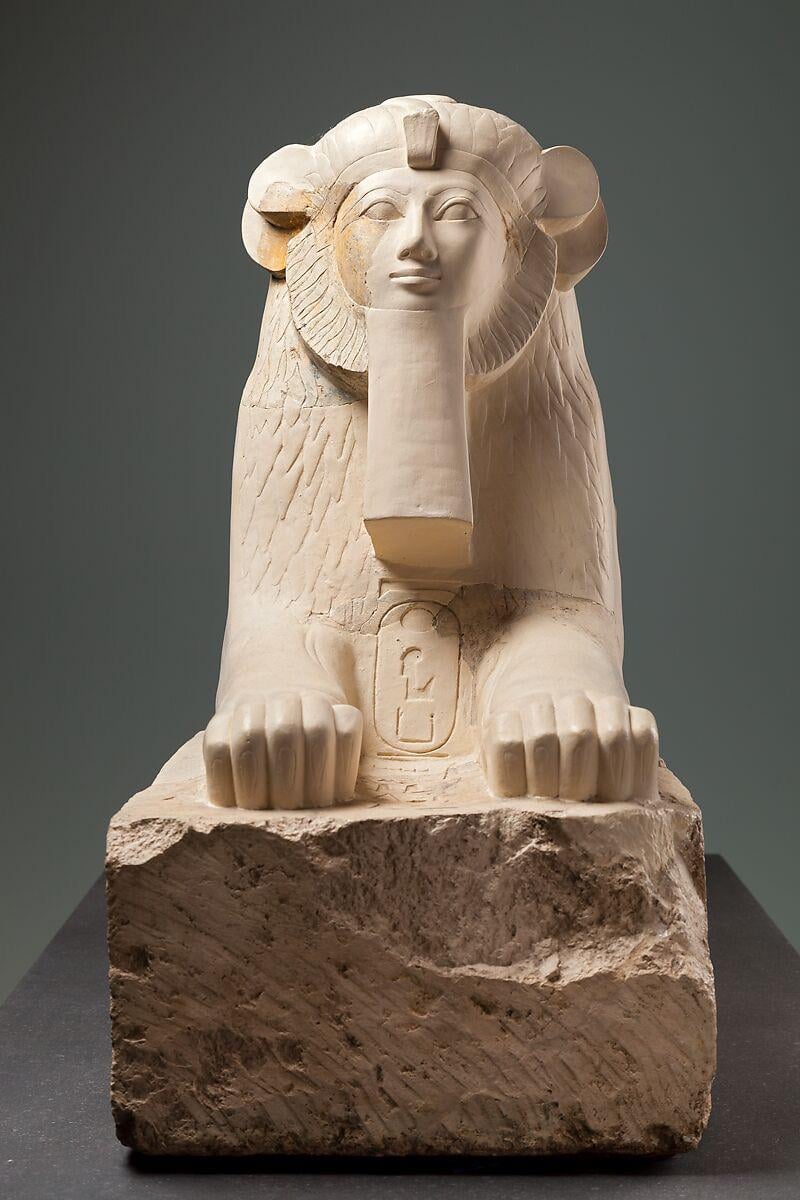
Sphinx of Hatshepsut
New Kingdom
ca. 1479–1458 B.C.
On view at The Metropolitan Museum of Art, Fifth Avenue in Gallery 117
The reconstructed sections of this sphinx have been cast from an almost identical, but more complete companion piece now in Cairo. The two small limestone sphinxes may have been on either side of the entrance to the upper terrace of Hatshepsut’s mortuary temple at Deir el-Bahri. The head of this sphinx differs markedly from Hatshepsut’s large sphinxes in which the human head wears the royal nemes-headcloth (see 31.3.166 and 31.3.167). Instead, this example was fashioned according to a type of sphinx bet known from the Middle Kingdom during the reign of Amenemhat III (ca. 1859-1813 B.C.). In this sphinx, the only human element is the face which is surrounded by a lion's mane. Remains of pigment show that the face was painted yellow, the color used for women in Egyptian Art.
Title: Sphinx of Hatshepsut
Period: New Kingdom
Dynasty: Dynasty 18
Reign: Joint reign of Hatshepsut and Thutmose III
Date: ca. 1479–1458 B.C.
Geography: From Egypt, Upper Egypt, Thebes, Deir el-Bahri, Senenmut Quarry, MMA excavations, 1926–28
Medium: Limestone, plaster
Dimensions: L. 106.7 × W. 33 × H. 63.5 cm, 196 kg (42 × 13 × 25 in., 432 lb.); H. (of base): 18 cm (7 1/16 in.)
Credit Line: Rogers Fund, 1931
Object Number: 31.3.94
by Handicapped-007