
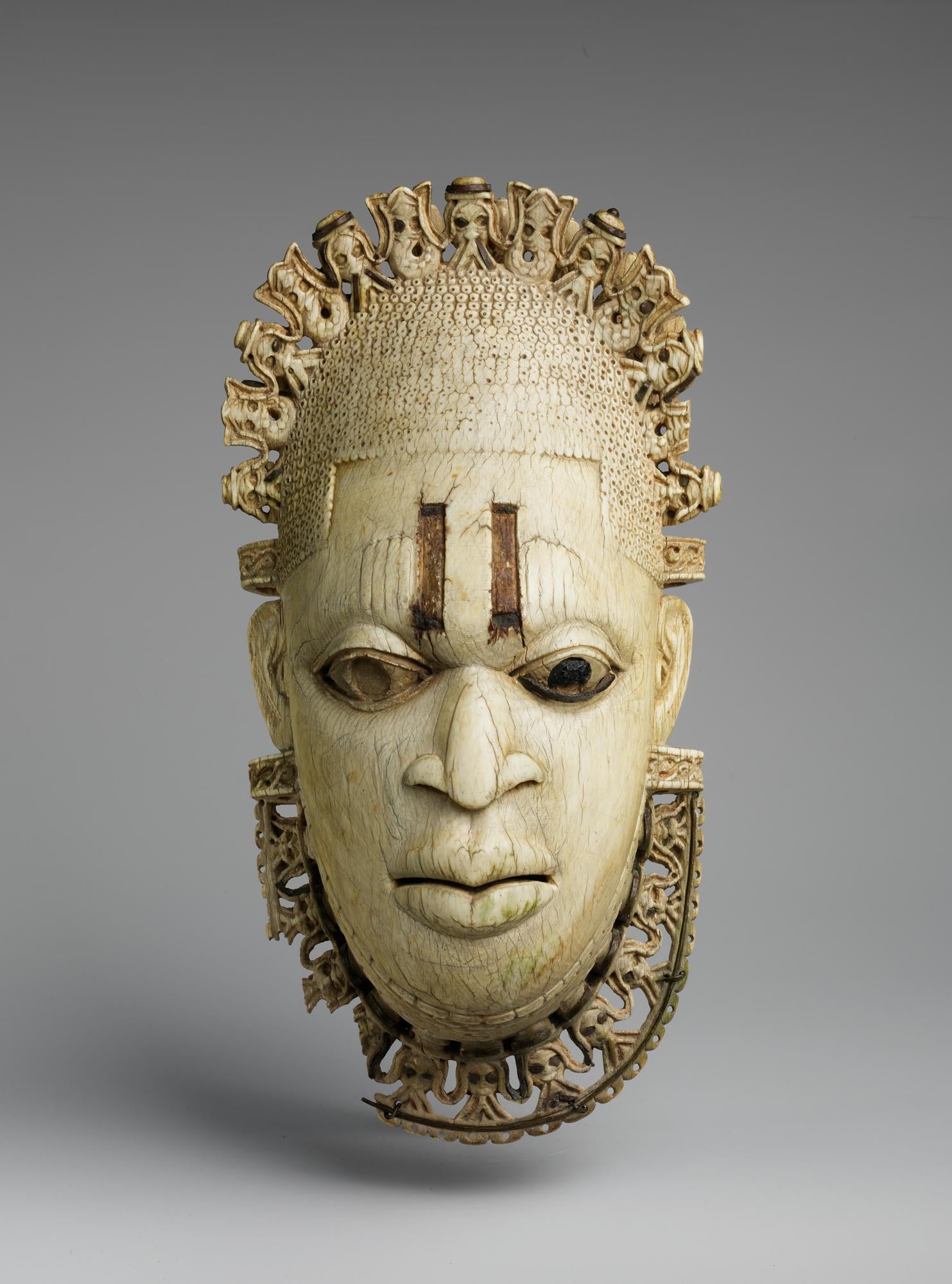
The pendant mask is believed to have been produced in the early sixteenth century for the King or ObaEsigie, the king of Benin, to honor his mother, Idia. The oba may have worn it at rites commemorating his mother, although today such pendants are worn at annual ceremonies of spiritual renewal and purification.
The mask is a sensitive, idealized portrait, depicting its subject with softly modeled features, bearing inlaid metal and carved scarification marks on the forehead, and wearing bands of coral beads below the chin. In the openwork tiara and collar are carved stylized mudfish and the bearded faces of Portuguese. Because they live both on land and in the water, mudfish represent the king's dual nature as human and divine. Having come from across the seas, the Portuguese were considered denizens of the spirit realm who brought wealth and power to the oba.
by DeScepter