
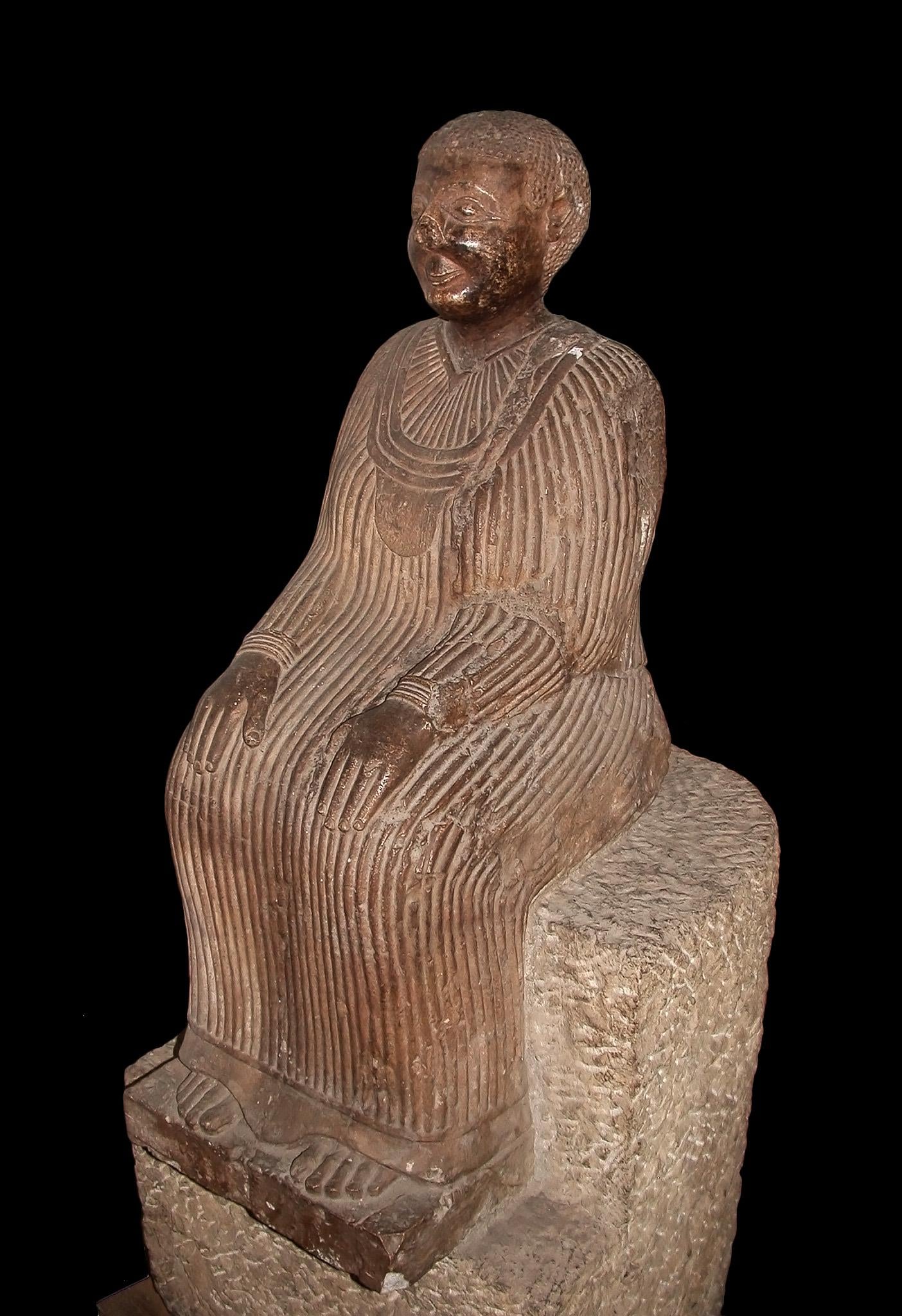
This statue, nicknamed the “Queen of Yeha,” is one of several depicting women (likely of noble status) found at archaeological sites across present day northern Ethiopia. Dated to around the 5th century BC (Haoulti et ses monuments, nouvelle interprétation, p. 132), it stands approximately 82 cm tall. It may represent a deity worshipped in the DʿMT period, such as Dat Ḥimyam (the goddess associated with the sun, fertility, and procreation, also present in South Arabia). The figure is dressed in what appears to be an early form of the kemis, a traditional garment still worn by Ethiopian and Eritrean women today.
Queens were especially revered in DʿMT society. Inscriptions from this period frequently highlight the maternal lineage of kings, suggesting a significant role for royal women. Given the possibility that this statue represents an actual queen, and its association with Yeha (likely the capital of DʿMT) it is plausible that she once resided in the palace complex of Grat Be'al Gebri, which is how she got her name.
Because information on DʿMT remains limited outside academic journals, I’m currently preparing a comprehensive article exploring its rulers, religion, settlements, and inscriptions. While that’s still in progress. I have published a on ይሐ / Yəḥa, which was likely the Capital Of DʿMT and is where a multi-storeyed palace, a grand temple, and elite burial tombs have been found.
While I provide citations/references for anything I do, Here is Some further reading, for anyone interested:
- Foundations of an African Civilisation: Aksum and the Northern Horn, 1000 BC – AD 1300 (Eastern Africa Series), particularly Chapter 3.
- “Yeha and Hawelti: Cultural Contacts between Saba and DʿMT – New Research by the German Archaeological Institute in Ethiopia” by Sarah Japp, Iris Gerlach, Holger Hitgen, and Mike Schnelle.
by NoPo552