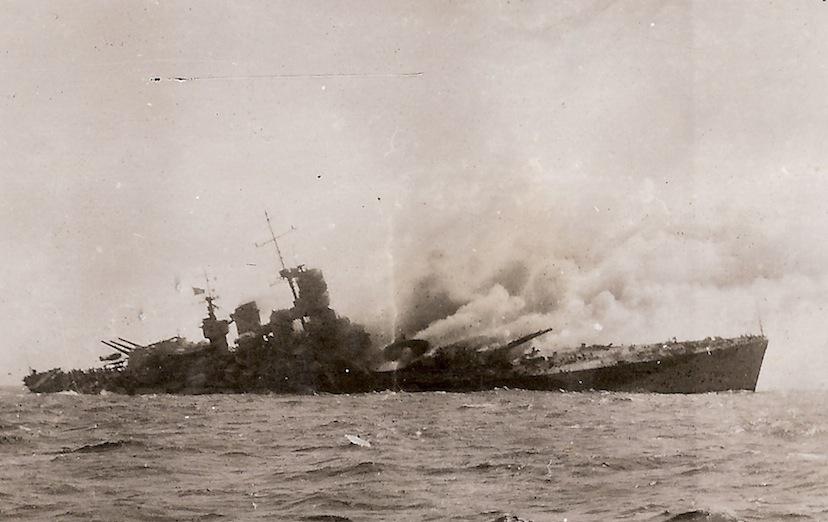
On this day 80 years ago the battleship Roma, flagship of the Italian battlefleet, was sunk by a Fritz-X bomb following the Armistice of Cassibile. 9 September 1943 [828 x 522]
On this day 80 years ago the battleship Roma, flagship of the Italian battlefleet, was sunk by a Fritz-X bomb following the Armistice of Cassibile. 9 September 1943 [828 x 522]
*Roma* was sunk by a FX-1400 guided bomb during a Luftwaffe attack on the Italian fleet which, in compliance with the terms of the Armistice of Cassibile, was sailing towards Malta (originally towards La Maddalena in Sardinia where it was supposed to stop for some time waiting for the situation to clear up, long story).
The German attack and the sinking of the *Roma* are thus described by Lieutenant Agostino Incisa della Rocchetta, fire control officer of the port side 90 mm anti-aircraft guns. Incisa, pictured [here](https://zafarranchopodcast.files.wordpress.com/2017/04/tv-agostino-incisa-della-rocchetta-roma-navigazione-in-prova.jpg) onboard *Roma*, was one of the survivors who were closer to the point where the bomb fell, causing the deflagration that sank the ship; he was also the highest ranking survivor, having personally given the order to abandon ship as all officers senior to him were dead or dying.
“*From 12:00 to 16:00 I was off duty (…) in my place in the port anti-aircraft fire director turret was Lieutenant Natale Contestabile. I was with the senior fire control officer, Lieutenant Commander Luigi Giugni, in the “technical artillery administrative office”, a semicircular room next to the conning tower, just below the bridge. (…) Suddenly I heard a voice: “Aircraft on the starboard side!” I immediately headed out of the room and I saw a German twin-engined aircraft. Immediately afterwards, a red light departed from its fuselage and the same voice as before said: “It made a recognition signal”. Whoever had said that was apparently right, as it seemed that the aircraft had dropped one of those flares that German aircraft used in order to be recognized by the ships: usually they split up into three or four stars of different colors, according to a sequence that had been agreed between German air force commands and Italian naval commands. But this time the flare did not split up, it came straight down, leaving a light blue-ish trail. A few seconds later, I saw a column of water rise about a hundred meters from Roma.*
*Only after such an obvious manifestation of hostility by the Germans, the “air attack alarm” signal was given on Roma, and thus Medanich, the fire director of the 90 [mm anti-aircraft guns] on the port side, was able to open fire on the second aircraft that was coming towards us (they attacked one at a time). He had been boiling with impatience for some time, as he had had the aircraft in his sights for a long time. In the meantime, I had gone to the bridge (…) I wanted to see someone from the command in order to receive some directive. I saw Captain Del Cima in the enclosed bridge, inspecting the sky with his binoculars, and I noticed that the forward armoured door of the conning tower was open. He did not say anything and I rushed towards my turret, from which Contestabile came out and I took his place. (…)*
*With my port guns I could only fire on the aircraft that were flying away after attacking us; a meager satisfaction, as this was a punitive fire, not a preventive one, which is the kind of fire that is essential for the safety of the ship.*
*I barely noticed the impact of the first bomb, as I did not feel the oscillations of the ship, being absorbed in [directing] the fire of my guns. However power went out for a few seconds and I saw with serious concern the gabion of the radar which, having detached from its support owing to the concussion caused by the bomb, had fallen onto the barrel of my no. 1 gun, blocking it; as I was about to order the crew of that plant to come out of the turret and throw the gabion into the sea, I was warned of another aircraft, approaching from the starboard. (…) I rotated the turret but I was unable to put it into the sights of the turret’s binoculars (…) so I followed it with my personal pair of binoculars. (…)*
*A few seconds passed; I am not sure if I saw the red flare detaching from the aircraft, but I remember, as if it were now, a huge black barrel that fell down, missing the turret by no more than one metre. We heard a dull thud and the power inside the turret went out. I gave the order to switch to the aft fire direction center, which was just aft of the turret, but a bit lower, and I jumped from the turret to the roof of the bridge [of the fire direction center]. There I found Contestabile, who asked me: “What’s happening?”, I answered: “It’s simple, a bomb fell and now steam and black smoke are coming out of here”. A thick cloud of steam mixed with smoke came out of a point located between the conning tower and the portside forward 152 mm turret. I had just finished saying that, when a tremendously violent puff came out of the bowels of the ship, the atmosphere around me became deep yellow and an unbearable wave of heat engulfed me.*
*I think that the ship was suddenly lifted and then violently fell back, as I found myself lying on the roof of the bridge, with my arms stretched forward. I saw the skin of my hands contract, wrinkle and take the dusky color of roasted meat; I felt all the skin of my face contract from the cheekbones, from the forehead, from the cheeks, from the chin, as if a huge hand of fire wanted to collect it in its fist, near the mouth.*
*There’s a ethnological museum in Rome, the Pigorini Museum, derived from the Kircherian Museum, founded by Jesuit father Kircher, where strange trophies of the Mundrukos (Brazil), Jivaros and Ochuali (Ecuador) natives are exposed. These are heads of enemies of these tribes, deboned and reduced to the size of a fist; their mouth is sewn shut with colored cords, so that they won’t be able to curse those who did that to them. I felt like my head had become like the ones at the museum: a terrible feeling.*
*It should be noted that I was not directly engulfed by the fire, but rather cooked by the reflection: I was 3 or 4 meters from the flame. All of this happened in 4 or 5 seconds (…) the burst of flame lasted a few seconds and in that short time it doomed our most modern battleship, but in that tragedy we had a little luck: there was a deflagration and not an explosion (…) The propellant charges of two 152 mm turrets and of one, perhaps two 381 mm turrets, caught fire all at the same time; several tons of cordite, which caused a powerful puff, a huge burst of flame, but did not explode. The explosive inside the shells was not involved, otherwise the ship would have been pulverized (…) TNT explodes, cordite deflagrates, at least ours (…) Roma’s magazines therefore deflagrated and allowed 1/3 of the crew to save themselves.*
*However the trauma, for me, had been so deep that I was so sure that the burns I had suffered would not allow my survival (I was, in other words, so sure I was going to die) that, being then as now a convinced Catholic, I prepared spiritually for death and I waited with calm and extraordinary serenity the moment of death. I was even curious to see what was beyond, without fear, with trust. Since then I have regretted that perfect preparedness for death, and I fear that it will not come back, that when my time comes I won’t have the time or the right spiritual disposition. Frankly, I consider that as a lost occasion.*
harrythom2018 on
The use of guided bombs in ww2 is quite interesting, we happen to have a fritz-x at the raf museum in Cosford, funny looking things back then

2 Comments
*Roma* was sunk by a FX-1400 guided bomb during a Luftwaffe attack on the Italian fleet which, in compliance with the terms of the Armistice of Cassibile, was sailing towards Malta (originally towards La Maddalena in Sardinia where it was supposed to stop for some time waiting for the situation to clear up, long story).
The German attack and the sinking of the *Roma* are thus described by Lieutenant Agostino Incisa della Rocchetta, fire control officer of the port side 90 mm anti-aircraft guns. Incisa, pictured [here](https://zafarranchopodcast.files.wordpress.com/2017/04/tv-agostino-incisa-della-rocchetta-roma-navigazione-in-prova.jpg) onboard *Roma*, was one of the survivors who were closer to the point where the bomb fell, causing the deflagration that sank the ship; he was also the highest ranking survivor, having personally given the order to abandon ship as all officers senior to him were dead or dying.
“*From 12:00 to 16:00 I was off duty (…) in my place in the port anti-aircraft fire director turret was Lieutenant Natale Contestabile. I was with the senior fire control officer, Lieutenant Commander Luigi Giugni, in the “technical artillery administrative office”, a semicircular room next to the conning tower, just below the bridge. (…) Suddenly I heard a voice: “Aircraft on the starboard side!” I immediately headed out of the room and I saw a German twin-engined aircraft. Immediately afterwards, a red light departed from its fuselage and the same voice as before said: “It made a recognition signal”. Whoever had said that was apparently right, as it seemed that the aircraft had dropped one of those flares that German aircraft used in order to be recognized by the ships: usually they split up into three or four stars of different colors, according to a sequence that had been agreed between German air force commands and Italian naval commands. But this time the flare did not split up, it came straight down, leaving a light blue-ish trail. A few seconds later, I saw a column of water rise about a hundred meters from Roma.*
*Only after such an obvious manifestation of hostility by the Germans, the “air attack alarm” signal was given on Roma, and thus Medanich, the fire director of the 90 [mm anti-aircraft guns] on the port side, was able to open fire on the second aircraft that was coming towards us (they attacked one at a time). He had been boiling with impatience for some time, as he had had the aircraft in his sights for a long time. In the meantime, I had gone to the bridge (…) I wanted to see someone from the command in order to receive some directive. I saw Captain Del Cima in the enclosed bridge, inspecting the sky with his binoculars, and I noticed that the forward armoured door of the conning tower was open. He did not say anything and I rushed towards my turret, from which Contestabile came out and I took his place. (…)*
*With my port guns I could only fire on the aircraft that were flying away after attacking us; a meager satisfaction, as this was a punitive fire, not a preventive one, which is the kind of fire that is essential for the safety of the ship.*
*I barely noticed the impact of the first bomb, as I did not feel the oscillations of the ship, being absorbed in [directing] the fire of my guns. However power went out for a few seconds and I saw with serious concern the gabion of the radar which, having detached from its support owing to the concussion caused by the bomb, had fallen onto the barrel of my no. 1 gun, blocking it; as I was about to order the crew of that plant to come out of the turret and throw the gabion into the sea, I was warned of another aircraft, approaching from the starboard. (…) I rotated the turret but I was unable to put it into the sights of the turret’s binoculars (…) so I followed it with my personal pair of binoculars. (…)*
*A few seconds passed; I am not sure if I saw the red flare detaching from the aircraft, but I remember, as if it were now, a huge black barrel that fell down, missing the turret by no more than one metre. We heard a dull thud and the power inside the turret went out. I gave the order to switch to the aft fire direction center, which was just aft of the turret, but a bit lower, and I jumped from the turret to the roof of the bridge [of the fire direction center]. There I found Contestabile, who asked me: “What’s happening?”, I answered: “It’s simple, a bomb fell and now steam and black smoke are coming out of here”. A thick cloud of steam mixed with smoke came out of a point located between the conning tower and the portside forward 152 mm turret. I had just finished saying that, when a tremendously violent puff came out of the bowels of the ship, the atmosphere around me became deep yellow and an unbearable wave of heat engulfed me.*
*I think that the ship was suddenly lifted and then violently fell back, as I found myself lying on the roof of the bridge, with my arms stretched forward. I saw the skin of my hands contract, wrinkle and take the dusky color of roasted meat; I felt all the skin of my face contract from the cheekbones, from the forehead, from the cheeks, from the chin, as if a huge hand of fire wanted to collect it in its fist, near the mouth.*
*There’s a ethnological museum in Rome, the Pigorini Museum, derived from the Kircherian Museum, founded by Jesuit father Kircher, where strange trophies of the Mundrukos (Brazil), Jivaros and Ochuali (Ecuador) natives are exposed. These are heads of enemies of these tribes, deboned and reduced to the size of a fist; their mouth is sewn shut with colored cords, so that they won’t be able to curse those who did that to them. I felt like my head had become like the ones at the museum: a terrible feeling.*
*It should be noted that I was not directly engulfed by the fire, but rather cooked by the reflection: I was 3 or 4 meters from the flame. All of this happened in 4 or 5 seconds (…) the burst of flame lasted a few seconds and in that short time it doomed our most modern battleship, but in that tragedy we had a little luck: there was a deflagration and not an explosion (…) The propellant charges of two 152 mm turrets and of one, perhaps two 381 mm turrets, caught fire all at the same time; several tons of cordite, which caused a powerful puff, a huge burst of flame, but did not explode. The explosive inside the shells was not involved, otherwise the ship would have been pulverized (…) TNT explodes, cordite deflagrates, at least ours (…) Roma’s magazines therefore deflagrated and allowed 1/3 of the crew to save themselves.*
*However the trauma, for me, had been so deep that I was so sure that the burns I had suffered would not allow my survival (I was, in other words, so sure I was going to die) that, being then as now a convinced Catholic, I prepared spiritually for death and I waited with calm and extraordinary serenity the moment of death. I was even curious to see what was beyond, without fear, with trust. Since then I have regretted that perfect preparedness for death, and I fear that it will not come back, that when my time comes I won’t have the time or the right spiritual disposition. Frankly, I consider that as a lost occasion.*
The use of guided bombs in ww2 is quite interesting, we happen to have a fritz-x at the raf museum in Cosford, funny looking things back then