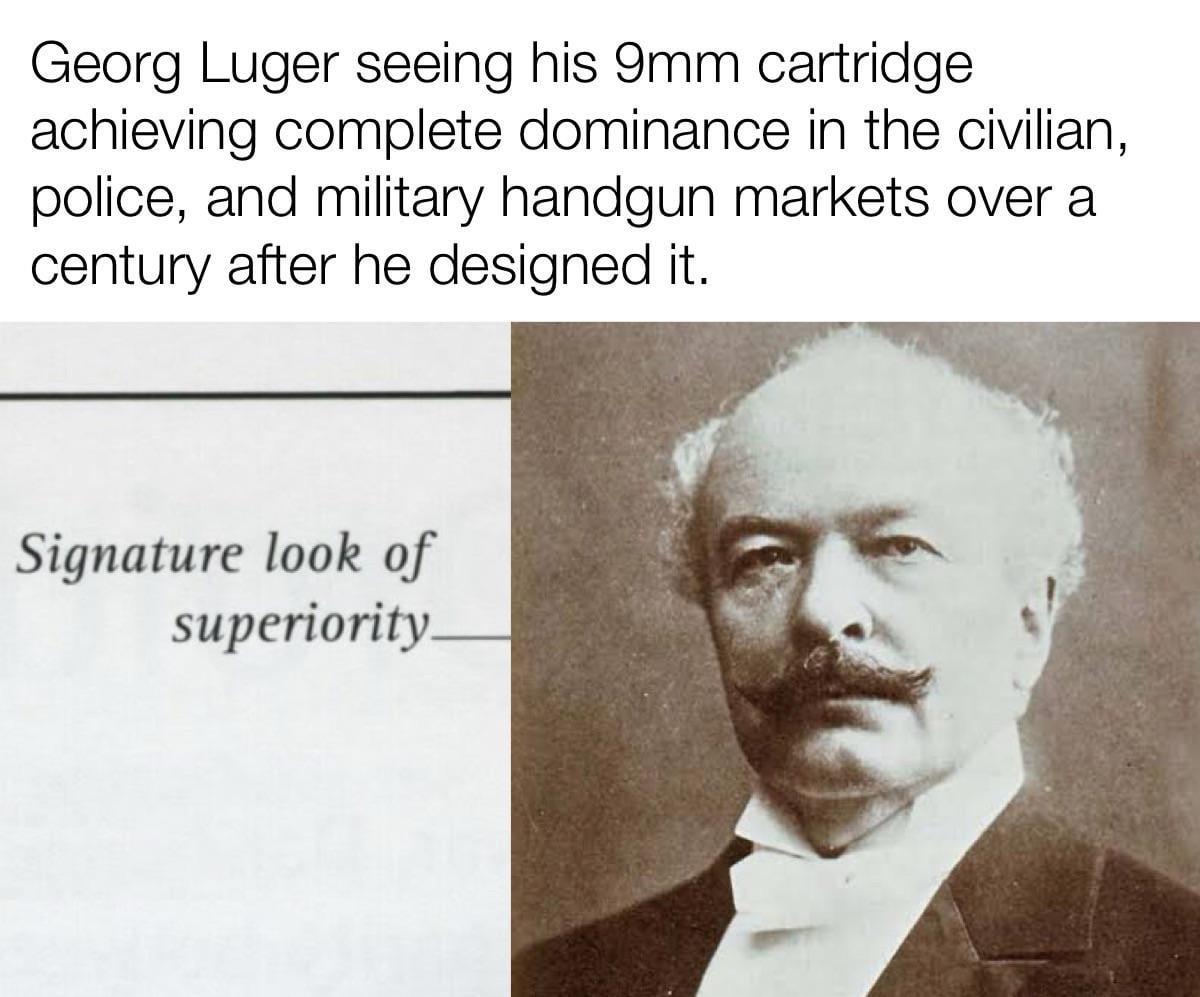
The 9mm Parabellum (9x19mm, also known as “9mm Luger”, “9mm NATO”, or simply “9mm” among other names), designed by Georg Luger in 1901, and has become one of the most successful handgun cartridges in history.
Initially developed for the Luger P08 pistol, it saw widespread adoption due to its balance of power, capacity, and controllability. By World War I and World War II, it had become the standard sidearm and submachine gun round for Germany and several other nations.
After World War II, the 9mm gained prominence in Western Europe, where it was adopted by NATO in 1962 as its official sidearm caliber, replacing a mix of .45 ACP, 9mm Brownimg, 7.65mm French Long, and other calibers used by member states. This decision was largely driven by the round’s lighter recoil, higher magazine capacity, and compatibility with widely available European firearms such as the FN Browning High Power.
In the United States, the 9mm replaced the .45 ACP in 1985 when the Beretta M9 was chosen to replace the M1911A1 as the U.S. military’s standard-issue sidearm. This decision was influenced by NATO standardization, increased magazine capacity, and the need to replace the inventory of aging 1911 pistols. The M9 served as the standard U.S. service pistol until its replacement by the SIG Sauer M17/M18 (also chambered in 9mm) in 2017.
The 9mm’s dominance in American law enforcement came later. Following the 1986 FBI Miami shootout, the agency initially adopted the 10mm Auto but found it had excessive recoil for many agents. This led to the development of the .40 S&W, a shorter, more manageable round that became dominant in the 1990s. However, advances in 9mm hollow-point technology and the FBI’s 2014 decision to return to the 9mm due to its improved performance, lower recoil, and higher capacity led to a rapid shift. Most U.S. law enforcement agencies, including those that had adopted the .40 S&W or others alternatives such as .357 Sig or .45 GAP, have also since switched to 9mm in the last ten years.
Internationally, the 9mm also displaced the 9x18mm Makarov, the standard Soviet bloc pistol caliber. After the collapse of the USSR, former Warsaw Pact nations transitioned to NATO standards, leading to widespread replacement of 9mm Makarov (or the older 7.62mm Tokarev) with 9mm Parabellum. Even in Russia and China, the 9mm Parabellum has become increasingly common among those nations militaries and law enforcement agencies.
Today, the 9mm is the most widely used handgun cartridge in the world, serving in military, law enforcement, and civilian roles across the globe. Its combination of affordability, effectiveness, and versatility ensures its continued dominance in the foreseeable future.
JustAnIdea3 on
This man was able to get Americans to use metric on their most beloved possessions.
DNathanHilliard on
I prefer the model 1911 .45, But I can see how the nine millimeter is probably the best all around compromise for a pistol.

4 Comments
The 9mm Parabellum (9x19mm, also known as “9mm Luger”, “9mm NATO”, or simply “9mm” among other names), designed by Georg Luger in 1901, and has become one of the most successful handgun cartridges in history.
Initially developed for the Luger P08 pistol, it saw widespread adoption due to its balance of power, capacity, and controllability. By World War I and World War II, it had become the standard sidearm and submachine gun round for Germany and several other nations.
After World War II, the 9mm gained prominence in Western Europe, where it was adopted by NATO in 1962 as its official sidearm caliber, replacing a mix of .45 ACP, 9mm Brownimg, 7.65mm French Long, and other calibers used by member states. This decision was largely driven by the round’s lighter recoil, higher magazine capacity, and compatibility with widely available European firearms such as the FN Browning High Power.
In the United States, the 9mm replaced the .45 ACP in 1985 when the Beretta M9 was chosen to replace the M1911A1 as the U.S. military’s standard-issue sidearm. This decision was influenced by NATO standardization, increased magazine capacity, and the need to replace the inventory of aging 1911 pistols. The M9 served as the standard U.S. service pistol until its replacement by the SIG Sauer M17/M18 (also chambered in 9mm) in 2017.
The 9mm’s dominance in American law enforcement came later. Following the 1986 FBI Miami shootout, the agency initially adopted the 10mm Auto but found it had excessive recoil for many agents. This led to the development of the .40 S&W, a shorter, more manageable round that became dominant in the 1990s. However, advances in 9mm hollow-point technology and the FBI’s 2014 decision to return to the 9mm due to its improved performance, lower recoil, and higher capacity led to a rapid shift. Most U.S. law enforcement agencies, including those that had adopted the .40 S&W or others alternatives such as .357 Sig or .45 GAP, have also since switched to 9mm in the last ten years.
Internationally, the 9mm also displaced the 9x18mm Makarov, the standard Soviet bloc pistol caliber. After the collapse of the USSR, former Warsaw Pact nations transitioned to NATO standards, leading to widespread replacement of 9mm Makarov (or the older 7.62mm Tokarev) with 9mm Parabellum. Even in Russia and China, the 9mm Parabellum has become increasingly common among those nations militaries and law enforcement agencies.
Today, the 9mm is the most widely used handgun cartridge in the world, serving in military, law enforcement, and civilian roles across the globe. Its combination of affordability, effectiveness, and versatility ensures its continued dominance in the foreseeable future.
This man was able to get Americans to use metric on their most beloved possessions.
I prefer the model 1911 .45, But I can see how the nine millimeter is probably the best all around compromise for a pistol.
Si vis pacem para bellum